Since I was in a video game mood this week...


 Ever hear of Motosada Mori? You probably have if you play Metal Gear Solid 3: Snake Eater. He's the brains behind the fighting system called CQC showcased in the video game. What's CQC? I'm glad you asked. It's a unique system of armed close quarter combat in which the operator uses a drawn pistol and knife at the same time. Still never heard of it? (Man, you really don't play video games...) I don't blame you. It seems no martial artist or operator (LEO, special agent, or other warrior of your choice) in the US has seen much of anything about this "revolutionary" system outside the video game.
 The obvious question is, "Does it work?" Beats me. It seems to work in the video game, but that's no test. Everything works according to script. (Certainly you don't believe Keanu Reeves can take on a room of kung fu fighters, do you?) While the techniques are suppossedly based on proven jujutsu and other Japanese budo styles, who knows if the new system works?
 Well, Motosada Mori should know. His credentials beyond video games are that he has trained SWAT-type teams in Japan. So what? (I mean that respectfully, but truly.) Proof is in the doing. With all the hype for "reality-based" fighting arts in the US (with rabid consumers in the martial arts, local, state, and federal agencies, and the military), and the blurring line between empty-hand martial arts, and the use of guns and knives, you'd think this CQC system would've taken off somewhere here. But I've heard zip. No buzz outside a few videogamers posting on the web who seem to have a hard time telling the difference between fantasy and reality.


 Sorry, I couldn't fit this one below. Chuck Heston as Nick Fury in True Lies.
 Ultimate Nick Fury bears an uncanny resemblance to Samuel L. Jackson. Go figure.

 Mego-style Nick Fury
 The Nick Fury SHIELD Needle Gun, designed by Jim Steranko
 The best Nick Fury was the Angelina Jolie version in the Sky Captain movie. (Just Kidding.)


 And let's not forget David Hasselhoff's gruff turn as Col. Fury. To prepare for the role, he stayed constipated for over a week. And yes, that's Lisa Rina as his sidekick Val. You remember her, she was also on Dancing with the Stars.
 Hasselhoff is his generation's Shatner. He'll have a major comeback someday.

 The first recorded sighting was in November of 1896, and in California, where all great fads must start. Over the course of the next year, there were hundreds of reported sightings of a long, cigar-shaped flying object the glided silently through the skies of the United States. Some reports said it had propellers, other talked about red and green lights. And a few even mentioned pilots. Before you knew it, we had the first major UFO sightings and the so-called Airship flap of 1897.
 Anyway, lacking terms like "airplane," "flying saucer," and "blimp," the public stuck on the Edwardian term "airship." Now, before you go thinking that this was some misapplication of the would "ship" to the same phenomena we would call UFOs and describe as interstellar space craft today, you have to understand how weird this story gets. The descriptions of the objects were often pretty exact, and while they do describe derrigibles pretty closely, these were not "space ship-like" objects in the least. The airships were rather ornately designed and made blimp-like objects with fishy fins, batty wings, carved wood furniture, paddle-wheel-type fans, all kinds of craziness.
Also, as the story grew, a few reports of a mysterious inventor appeared, who was jealously guarding his secret in order to get it to the Patent Office after his "flight tests." One California attorney even stepped forward claiming to represent the inventor. In addition, there were stories of the airships landing and the pilots interacting with locals. In one case asking for some "lubricating oil, cold chisels, and bluestone." (Bluestone happens to be the predominant rock type in Stonehenge monuments, but whether or not that is in any way related is your guess.)
There was only one report that a crashed airship was from Mars. This happened in Aurora, Texas. The mystery pilot was buried (at least, according to the story) and his location was known until investigators, real newspaper reporters, went looking for him in the 1970's. The cemetery claimed they had meticulous records, and had no record of a John Doe related to this incident. However, the story surfaced that someone had exhumed the body and moved the gravestone.
So what is the likely truth? Was there a mysterious airship inventor? Well, in this case, the possibility isn't 100% impossible, but it is against the odds. What we do know is that the world was a very different place back then. Newspapers in the 1890s were known for enlivening slow newsdays with the kinds of distant wire reports we today only see in the Weekly World News. Telegraph operators use to entertain each other by making up outlandish stories to pass back and forth between each other, and sometimes these bogus stories were mistaken -- or intentionally passed off -- for real news. Maybe there was a kernel of truth to a few of these wild reports, but few have any hard evidence to attach to them. And we also know that no inventor, or his attorney, ever did file a related patent for an airship. At least, not in the United States...


I just have to share my delight in receiving my long awaited Kurgan action figure from Sideshow Toys.
The mighty villain from the first (but lamentably, not the only) Highlander movie stands an impressive 13 inches tall. He comes dressed in faux black leather and is equipped with his imposing double-edged broadsword.
The headsculpt is accurate for actor Clancy Brown, but the grimace makes this film fan realize how much acting Mr. Brown really did with his expressions. One of the great things about the Kurgan was his absolute glee in doing his dirty work. Here was a villain who relished his job! He smiled much more often than he snarled.
My complaints are minor: The Sideshow exclusive version's extra was the decapitated head of the Immortal Moor, Kasimir. I'm sure I'm not alone in wishing for the movie's signature trick, the briefcase containing the break down longsword. (Sure, it was unrealistic from a swordmaking point of view, but it was a great visual gag!) The uncovered right arm looks a little scrawny with all the joints exposed.
Yes, action figure collectors are all aflutter waiting for the full-battle armor version of the figure.
All in all, a great addition to the jrf collection. Now, I'll need to be on the lookout for some 1/6 scale nuns for him to menace...
 Shortly before they tested the Atomic Bomb, Manhattan Project scientists fretted about the possible effects of detonating the device. One worry was that the explosion might start an uncontrolled chain reaction and ignite the atmosphere. Despite the uncertainty, the test went on as scheduled. Obviously, the earth survived. But when stories like this began to circulate, the public imagination was caught by the notion that the US governemtn was willing to risk everything to pursue scientific superweapons to win the war.
 I'd like to say a few words about the utility of Airsoft guns as part of your martial arts training regimen.
 If you're a "mil-head" or a "Geardo" then you should know about Military Morons. Military Morons is a website for those of you who for personal or professional reasons get weak-kneed at the thought of olive drab cordura. If your idea of a Christmas gift is a pair of Gore-Tex combat boots, or you own more ammo pouches than ammo magazines, you are the ideal visitor to this website.
 After signing the paperwork to join a martial arts dojo, the next investment most students make is a shiny new uniform. This is called a Gi, although this is a shortened form of the words dogi or keikogi. These uniforms are mass produced in genuine polyesther, and many schools will give the new student a cheapo starter set as part of the package deal. This is smart if your school wants to ensure a uniform look, or silk-screen your school logo onto the back of the jacket.
 Generally speaking, there are three basic parts to the uniform: the jacket, the trousers, and the belt. Premium uniforms are usually made of heavy weight cotton. Karate gi are typically a cotton duck, and when starched make a nice "pop" when a punch is executed well. Karate gi also have ties at the waist to keep the jacket neatly gathered during practice. Karate trousers are plain, and usually pulled shut at the waist with a drawstring. Judo, Jujutsu and Aikido gi jackets are typically made of a softer cotton with reinforced seams that will stand up to the jerks, tugs, and pulls of these grappling arts. The lapels are often stiff and have adjacent grab panels built into the jacket. Typically, there are no waist ties on these jackets and they are kept closed by the belt. The lower third of the jacket usually has a subtle diamond pattern woven into the fabric. Some traditional jujutsu styles use a slightly different style more-popular with Kendo or Kyudo students. This style is longer hemmed, and features a single tie about chest-high. The trousers for grappling arts typically continue the re-inforced stitching and also feature quilted panels over the knees. These knee panels help stand-up to the extra wear from rolling around on the mat.
 Traditionally, gi were white, or vanilla colored. Today, however, you can get a gi in white, black, blue, red, or even more exotic custom colors. White and black seem to be the most popular. However, crazy styles are gaining traction in the fashion concious United States. Everything from star-spangled red-white-and-blue patriotic prints to v-necked pullover tops can be had.
 The traditional gi worn in a particular way. First, the student slips on the jacket. Then the trousers are put on and tied closed. The jacket is then wrapped closed; first the right side is wrapped around the body, then the left side is wraps closed over the right side. Then the belt is donned. The belt, or obi, comes in a rainbow of colors. Universally the first color is white, after that, the sky is the limit. A black belt is usually the last color awarded -- but in this ego driven age, all kinds of different-colored belts can be the ultimate goal. It all depends on the school. The diagram above shows how to wear the belt. Explaining how to wear the belt is easier to do by showing than by describing. Just one of many such bits of knowledge passed down through the arts.
 Gi descended from undergarments, and were very plain and homely because of that. Only recently have some traditional styles been willing to lean forward regarding fashion and allow simple marks such as kanji. The example above has Kyokushinkan karate embroidered on the chest. Of course, many schools will hand out jackets with the school logo printed on it. Frequently, the student will be required to put his or her name on the front, so teachers can keep everyone straight. This is a necessity in large schools, and especially if student turnover is high. Of course, a brief review of martial arts supply catalogs will reveal an enormous assortment of multi-colored patches to be awarded for everything from good attendance to super report cards to nunchuku mastery. These patches are good incentive for some students and serve good purposes. Still, my preference leans towards simplicty. I like a few meaningful kanji at most.
 While this costume fits Mrs. Affleck well and keeps viewers interested in an otherwise dismal film, it is a far cry from a traditional martial arts practice uniform.
 OK, this is a little wierd. As if the lives recorded by blogs weren't strange by themselves, the latest thing is to have fictional characters blogging.
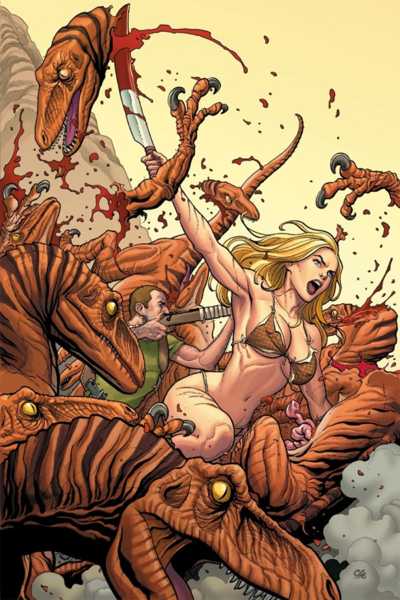
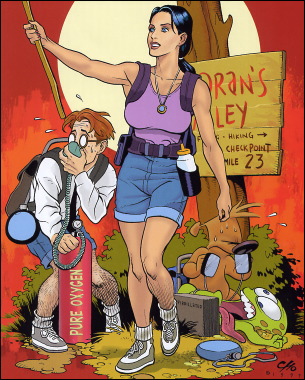
 A few samplings of Frank Cho's comic art and illustration. If you're interested in more about Mr. Cho, visit his website.