


Wednesday, March 29, 2006
Down the hallway. Third door on the left...
Nestled right between the Ministry of Silly Walks and the Bureau of Redundancy Department lies the office of The Bureau of Workplace Interruptions.

Scientific Experiments Gone Horribly Wrong!
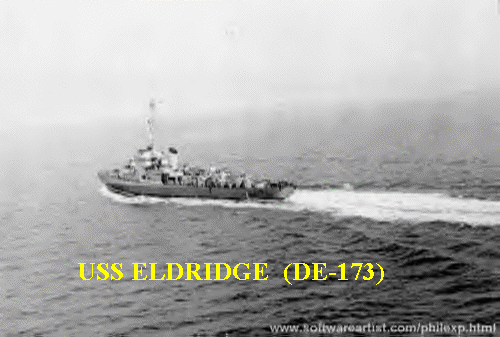 Shortly before they tested the Atomic Bomb, Manhattan Project scientists fretted about the possible effects of detonating the device. One worry was that the explosion might start an uncontrolled chain reaction and ignite the atmosphere. Despite the uncertainty, the test went on as scheduled. Obviously, the earth survived. But when stories like this began to circulate, the public imagination was caught by the notion that the US governemtn was willing to risk everything to pursue scientific superweapons to win the war.
Is it any wonder that the story of the "Philadelphia Experiment" began to circulate? (Note the similarity of name with the Manhattan Project.)
While the story of the Philadelphia Experiment is not directly related to nuclear weapons, it is clearly a manifestation of the anxiety caused by harnessing risky energies using the cutting edge of scientific research.
According to the story, the Navy outfitted a destroyer escort, USS Eldridge (Eldritch, anyone?), with an experiemental power generator (according to some version, built on plans from Nikola Tesla's drawing board) to test the capability of rendering a ship invisible. The first test was a qualified success in that the ship was replaced by a green fog. The equipment was recalibrated for a second test. During this second attempt, the ship disappeared from the Philadelphia Naval Yard in a blinding flash of blue light and was reportedly seen off the coast of Norfolk, VA, before returning in the same mysterious fashion to Philadelphia. Since uncontrolled teleportation made the Navy nervous, they apparently gave up the experiment at this point.
The story continues in the 1960's, when certain unexplained documents pertaining to the incident were mailed to the Office of Naval Research. These documents were annotated by two commentators with an unusual use of EnGliSH CapITALizatIOn and Punc.Tua;))tion.! The story revealed in the documents and notes elaborated on the effects of the experiment upon the ship's crew members.
It seems that sudden teleportation was not without some risk. Some crewman were fused with mechanical equipment. Others emerged deformed. Some appeared normal, but later manifested psychic or superhuman powers. (Keep in mind that this particular mutation of the story comes at a time when the consequences of certain real activities -- exposing hundreds of Army troops to nuclear tests -- were becoming known. You can see how the anxiety emerges in the folklore.)
After that, the mainstream conspiracy theory of the Philadelphia Experiement begins to branch. It became caught up with novels, "non-fiction" books, movies, TV specials, you name it. These stories fed on each other, and borrowed liberally from other sources. The Philadelphia Experiment has been a self-titled movie, mentioned on the X-Files, and elements of the story were lifted for this season's failed series Threshold. The Sci-Fi Channel series, "The Triangle" blames the Bermuda Triangle mystery on forces unleashed by the Philadelphia Experiment.
Proof that this was too good a conspiracy theory is that it spawned a spin-off called the Montauk Project (again, note the similarity in name to Manhattan Project). In this story, the government closed up the original experiment following the failures and continued the research at an underground facility on Montauk in New York state. You want wacky? This is wacky.
The Montauk Project succeeded in stabilizing the "electromagnetic bottle" that enveloped the Eldridge. This technology lead to breakthroughs in teleportation and the construction of a Time Tunnel device. Now, government agents could be transported to any point in history. It was even used to "capture" the Eldridge in the midst of the original experiment and trap it in hyperspace. During this incident, two sailors supposedly jumped ship and found themselves in 1982, some 40 years distant from their loved ones. This story was used as the basis for the movie. Of course, the time tunnel was also used to contact space aliens -- who helpfully shared their technology to enhance the Montauk Project. And let's not forget the giant monster that was somehow sucked through the device and rampaged through the facility.
(I have to mention that Time Tunnel was a sci-fi TV series brought to you by Irwin Allen, the same genius who gave us Lost in Space. It would have been on TV at roughly the same time the actual project was occurring. Either this was exceptionally sloppy, or exceptionally brilliant security -- depending on your conspiracy worldview.)
There's not one shred of hard evidence for the truth of any of the above. It strains credibility. There's plenty of evidence to the contrary. Proponents of this far-fetched idea insist that all eyewitnesses (and there had to be hundreds of people involved over the course of decades) are:
a.) loyal conspirators, b.) falsly discredited as cranks, c.) dead from natural or human causes, or d.) brainwashed to forget. It's a great story, nontheless. And the paranoia is fascinating.
Wednesday, March 22, 2006
Airsoft
 I'd like to say a few words about the utility of Airsoft guns as part of your martial arts training regimen.
At some point in training, every martial artist is taught a few nifty gun disarms. These are almost always prefaced by the standard words from sensei about "Only try this in the most life-threatening situations." Usually, the disarming movements are taught with a simple mock-up. When I started my training -- many years ago -- the state of the art was a pistol shaped chunk o'wood. Some forward thinkers used lightweight toy pistols. Nowadays, we can choose from a variety of plastic guns made to more realistic designs and weights. I have a couple of ASP red guns which nicely mimic weapons I am frequently around.
While these are nice, they still don't go bang. Enter Airsoft pistols. These little Asian imports are made to resemble every real firearm in existence. They use a bit of compressed air to shoot a 6mm bb with just enough oomph to sting you (or put out an eye if you don't use goggles -- so use care and goggles). I cheap model can be had for as little as $19.95. What's nice about these is that in disarm training, you can actually have your assailant pull the trigger. This adds an urgency to your movement and teaches you the real limitations of handgun disarm techniques.
It isn't perfect. For one, the person performing the disarm has to be careful not to break the shooter's finger when the weapon is peeled out of the hand. Second, the secondary effects of close-range gunshots (light, noise, heat flash, and shock wave) are not accounted for bor the little poof of air. But it can make you think different about your super-human martial arts abilities.
I also own a repeater airsoft pistol to practice basic marksmanship skills in my own house. It's much cheaper in time and money than going to the range everyday to maintain those deadly point and shoot abilities. I can practice my presentation, sight picture, breath control, and trigger press. The airsoft also lets me practice magazine changing drills and reholstering. Again, it isn't exactly the same as a real pistol, but it's pretty damn close. And it's convenient. For those of us how don't have ammo budgets larger than the Marine Corps, or the ability to bulletproof our basements, it's a reasonable alternative and adjunct to live fire range time.
I know this may be heresy to professional gunfighters. But I'm not a pro gunslinger. I take my training where I can fit it in. And really, is a quality airsoft pistol any less than the modern equivalent to a bokken?
Military Morons
 If you're a "mil-head" or a "Geardo" then you should know about Military Morons. Military Morons is a website for those of you who for personal or professional reasons get weak-kneed at the thought of olive drab cordura. If your idea of a Christmas gift is a pair of Gore-Tex combat boots, or you own more ammo pouches than ammo magazines, you are the ideal visitor to this website.
Run by a self-confessed "wanna-be" the site grew from an airsoft freak with more cash than common sense to a tipping-point website of gear reviews. Many of the new and innovative tactical gear companies actually send this guy equipment to "test" (mostly for fit and comfort) and review. If he pronounces something cool, then it has instant cachet in the world of tactical geeks. And he tends to be right about the "cool" factor.
If you fall into the group that thinks Military Morons is neat (for whatever reason) you should know about the two grand-daddy tactical gear firms: Blackhawk (which happens to be running a sale) and Eagle Industries. There are plenty of other manufacturers: London Bridge, Tactical Tailor, Spec Ops Brand, and Maxpedition to name a few. In our current age, when the soccer mom drives her brood to practice in a Hummer, there is something undeniably cool about stuffing your brown bag lunch and work portfolio into a tough-as-nails Coyote Brown Three Day Assault Pack.
Sunday, March 05, 2006
Training Uniform
 After signing the paperwork to join a martial arts dojo, the next investment most students make is a shiny new uniform. This is called a Gi, although this is a shortened form of the words dogi or keikogi. These uniforms are mass produced in genuine polyesther, and many schools will give the new student a cheapo starter set as part of the package deal. This is smart if your school wants to ensure a uniform look, or silk-screen your school logo onto the back of the jacket.
 Generally speaking, there are three basic parts to the uniform: the jacket, the trousers, and the belt. Premium uniforms are usually made of heavy weight cotton. Karate gi are typically a cotton duck, and when starched make a nice "pop" when a punch is executed well. Karate gi also have ties at the waist to keep the jacket neatly gathered during practice. Karate trousers are plain, and usually pulled shut at the waist with a drawstring. Judo, Jujutsu and Aikido gi jackets are typically made of a softer cotton with reinforced seams that will stand up to the jerks, tugs, and pulls of these grappling arts. The lapels are often stiff and have adjacent grab panels built into the jacket. Typically, there are no waist ties on these jackets and they are kept closed by the belt. The lower third of the jacket usually has a subtle diamond pattern woven into the fabric. Some traditional jujutsu styles use a slightly different style more-popular with Kendo or Kyudo students. This style is longer hemmed, and features a single tie about chest-high. The trousers for grappling arts typically continue the re-inforced stitching and also feature quilted panels over the knees. These knee panels help stand-up to the extra wear from rolling around on the mat.
 Traditionally, gi were white, or vanilla colored. Today, however, you can get a gi in white, black, blue, red, or even more exotic custom colors. White and black seem to be the most popular. However, crazy styles are gaining traction in the fashion concious United States. Everything from star-spangled red-white-and-blue patriotic prints to v-necked pullover tops can be had.
 The traditional gi worn in a particular way. First, the student slips on the jacket. Then the trousers are put on and tied closed. The jacket is then wrapped closed; first the right side is wrapped around the body, then the left side is wraps closed over the right side. Then the belt is donned. The belt, or obi, comes in a rainbow of colors. Universally the first color is white, after that, the sky is the limit. A black belt is usually the last color awarded -- but in this ego driven age, all kinds of different-colored belts can be the ultimate goal. It all depends on the school. The diagram above shows how to wear the belt. Explaining how to wear the belt is easier to do by showing than by describing. Just one of many such bits of knowledge passed down through the arts.
 Gi descended from undergarments, and were very plain and homely because of that. Only recently have some traditional styles been willing to lean forward regarding fashion and allow simple marks such as kanji. The example above has Kyokushinkan karate embroidered on the chest. Of course, many schools will hand out jackets with the school logo printed on it. Frequently, the student will be required to put his or her name on the front, so teachers can keep everyone straight. This is a necessity in large schools, and especially if student turnover is high. Of course, a brief review of martial arts supply catalogs will reveal an enormous assortment of multi-colored patches to be awarded for everything from good attendance to super report cards to nunchuku mastery. These patches are good incentive for some students and serve good purposes. Still, my preference leans towards simplicty. I like a few meaningful kanji at most.
 While this costume fits Mrs. Affleck well and keeps viewers interested in an otherwise dismal film, it is a far cry from a traditional martial arts practice uniform.
Fictional Lives
 OK, this is a little wierd. As if the lives recorded by blogs weren't strange by themselves, the latest thing is to have fictional characters blogging.
One of the most popular is Schrute-Space, by Dwight Schrute, a character on The Office. It's even spun off a MySpace.com entry.
There's also Barney Stinson, of How I Met Your Mother, with Barney's Blog. He offers bad dating advice. If you like that kind of thing, let me know: I can offer plety here.
If you're into conspiracy theories and freaky aliens, there's always Dave, the kooky brother-in-law on Invasion, with his Dave's Diatribe.
Sadly, the only computer available to the castaways of Lost is a 1980's era junker. And they've been warned not to use it for anything other than entering those freaky numbers. So, no one will be checking out Kate or Ana-Lucia's blog any time soon. Of course, we're also spared Sawyer's and Eko's blogs. However, there are sites for the freaky Dharma Initiative and Hanzo Foundation (unfortunately, the Hanso site seems to be down).
Here are some other Lost websites you might be interested in.
Favorite Artists: Frank Cho
 A few samplings of Frank Cho's comic art and illustration. If you're interested in more about Mr. Cho, visit his website.






Teutonic Knights
 Although most people who have heard of the Crusades would correctly say that they were fought between Christians and Muslims in the Holy Land, I'd venture to say that many people would be unaware that Crusades were also called against other enemies of the Church in the Middle Ages. The Spanish Reconquista was one such Crusade. The Albigensian Crusade in Southern France was another Crusade. But as the Middle Ages continued, Crusades were also called against the pagan peoples of Eastern Europe.
 The shock troops of the Church in Eastern Europe were the Teutonic Knights, a military order like the Templars and Hospitallers. They were originally organized under the Templar Rule. They grew to be so powerful a force that they ruled their own state, which was the basis for the politicial boundaries of Prussia, and later the core of modern Germany. Their dominion extended into Poland and parts of the Ukraine and Russia.
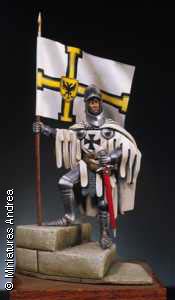
 The heraldry of the Teutonic Knights was black on white, with gold trim and other details. Their equipment and iconogrpahy was particularly gothic in design. The extensive detail in their uniforms, based on a simple color scheme has made them popular subjects for military modelers, as evidenced by the accompanying photographs.
 The best known battle involving the Teutonic Knights was the so-called "Ice Battle" related in the epic tale of Alexander Nevsky, and most recently riffed on in the Clive Owen film version of King Arthur. The knights were fighting a winter campaign against the Russian pagans, led by Nevsky. Nevsky lured them onto a frozen lake. The ice cracked under the weight of the heavily armored knights and charging horses, and hundreds of the brothers drowned.
 With the best of their Order lost in such a humiliating defeat, the Teutonic Knights abandoned the campaign.
 Like all of the Crusading Orders, the Teutonic Knights were renowned for their fierce devotion to the Christian Faith. However, also like the Templars, they were dogged by rumors of being more interested in worldly affairs, wealth, and power. Their were undeniably ruthless in the pursuit of their cause.
 Perhaps the most chilling legacy of the Teutonic Knights is not their fault at all. Due to their Germanic origins, martial prowess, and reputation for devotion to their cause, Hitler used them as an inspirational model for his SS. The example even went so far as to build SS retreats using the floorplan on Teutonic Order keeps.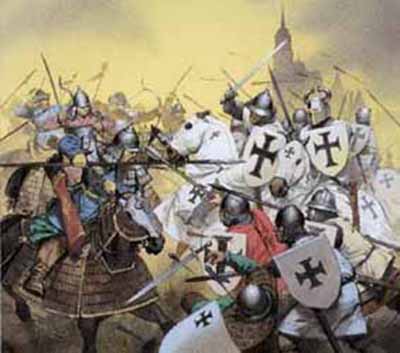
Wednesday, March 01, 2006
Pint Size Elektra!

Oh boy! Does anyone have the pattern for this? In 5 or 6 years, this would be the perfect Halloween costume for my little ninja girl! Cool.
Go Ninja!
 YO! It’s the green machine --
Gonna rock the town without bein’ seen
Have you ever seen a turtle
Get Down? --
Slammin’ Jammin’ to the new swing sound
Yeah, everybody let’s move --
Vanilla is here with the new Jack Groove
Gonna rock, and roll this place --
With the power of the ninja turtle bass
Iceman, ya know I’m not playin’ --
Devistate the show while the turtles are sayin:
Chorus:
Ninja, Ninja, RAP! Ninja, Ninja, RAP!
GO GO GO
Go Ninja, Go Ninja, GO; Go Ninja, Go ninja, GO!
Go Ninja, Go Ninja. GO; Go Ninja, Go ninja, GO!
GO GO GO GO
Lyrics, fill in the gap --
Drop that bass and get the NINJA RAP
Feel it, if you know what I mean --
Give it up for those heroes in green
Just flowin, smooth with the power --
Kickin’ it up, hour after hour
Cause in this life there’s only one winner --
You better aim good so you can hit the center
In it to win it, with a team of four --
Ninja Turtles that you gotta adore it’s the:
Chorus:
Ninja, Ninja, RAP! Ninja, Ninja, RAP!
GO GO GO
Go Ninja, Go Ninja, GO; Go Ninja, Go ninja, GO!
Go Ninja, Go Ninja. GO; Go Ninja, Go ninja, GO!
GO GO GO GO
Villians, you better run and hide --
Because one day you might not slide
Choose your weapon but don’t slip --
Vanilla’s in control with the flex of the mic grip
Rockin’ the crowd the way it should be rocked --
With the Miami drop that you like alot
Hittin like a Ninja Turtle when the bass kicks in --
You better check your level
The power of the Ninja is strong --
Fightin’ all the crooks until they’re all out cold


 Tell me the story, tell me the legend
Tell me the tales of war
Tell me just one time,
What it was like before
Bring me the feeling, right in that moment
When a heart for battle cries
Find me the treasure where the legend lies.
If I were a noble ancient knight
I’d stand by jour side to rule and fight
It will always feel the same
When I call out your name.
Ninja survive, in dreams I walk by your side
Ninja survive, with you there’s no need to hide.
A handful of sayings are more than a reason
For me to feel this way
I’d like to be near you
Maybe for just one day
So tell me the legend, tell me the story
Tell me the tales of war
Tell me just one time
What it was like before.

Well, I never claimed to have taste...


Vanessa Marcil


 "Pig tails. Very Naughty."
Bonus points to the person who can identify the movie, actor, character for that quote.
Subscribe to:
Comments (Atom)