


Wednesday, October 25, 2006

Bujinkan Hombu Dojo
 I have, unfortunately, never been to the Bujinkan Hombu Dojo in Japan. Maybe someday.
 The Hombu Dojo is somewhat unusual among dojos in the sentimental clutter adorning the walls. It may come across to those unfamiliar with Hatsumi sensei as the martial arts version of a Bennigans, Chilis, or Applebees. This kind of sentimental attachment to souveniers is a little unusal for Japanese, but not for Hatsumi sensei. The decor is also the result of decades of foreign visitors bringing gifts to Soke. Gift giving in Japan has some odd rules, and in one sense, Hatsumi's receipt of a gift actually does place an obligation upon him not only to accept the gift gracefully, but keep and maintain the gift.
 This is the Shomen of the Dojo. This is the wall that is the focal point of the dojo, and quite rightly has the Kamidana shelf and the Shinden that is the Shinto shrine.
 The Shinden is a typical feature of the traditional Japanese dojo. What is very unusual for a Japanese dojo is that the Shomen also houses the racks of various weapons. Usually, the Shomen is kept neat and uncluttered. The only distinguishing feature is the Kamidana and the various accessories that go on and around it. If you are interested in why this is unusual, and what possible significance the Bujinkan arrangement might have, please read Dave Lowry's In the Dojo, a book a recommended several weeks ago.


 The Hombu Dojo is small. This is also not unusual for Japanese dojo.
Sunday, October 22, 2006
Wednesday, October 18, 2006
Coming to Grips with a Dangerous Situation


Few subjectsget the knife fighting crowd more stirred up than the "correct wa(s)" to hold a knife. Crazy methids of gripping leap out of the woodwork.
Look, without getting wildly technical, there are basically two ways to hold a knife:
"Forward." The knife is held so the blade extends up from the thumb.
"Reverse." The knife blade extends below the heel of the hand.
All the main variations entail the angle of the blade to the arm, and the super important (yeah, right) placement of the fingers -- especially the thumb. What gets all the so-called experts in a dither is that digit placement... Again, you want some good, basic advice? Hold the knife so you can really hold it. Any finger placement that risks losing the knife is probably not good.
Anyway, my martial arts class got involved in a discussion of the reverse grip. It seems the question arose about whether the sharp edge of the blade belongs to the outside (i.e. away from the forearm and towards your attacker) or inside (i.e. facing the forearm and away from your attacker). The class, for whatever reason, split about 75% in favor of an outside reverse grip.
Our Teacher and Fearless Leader (FL) had contacted his own instructor, a rather well-known and respected martial artist ("He Who Shall Remain Nameless," or HWSRN) on the question. HWSRN also believes in an outside reverse grip. His standard answer was apparently provided: "Keep the dangerous part of the weapon between you and the bad guy."
I emailed my FL the following story, and now post it here for whatever it is worth...
I had a drinking buddy for many years named Bush (uh, no... not the famous one). Bush was a great storyteller and a former Marine. We talked about life, the universe and everything while drinking. The subject of knife fighting came up exactly once.
The Marines gave Bush a single block of instruction on how to use a Ka-Bar knife in combat. He learned the proper way to slit a throat and how to hold his knife in a last-ditch struggle.
The Marines told Bush to always grip the knife in the outside reverse grip. All he then had to do was punch and fight like his life depended on it. The idea was that punching was a pretty natural fighting reaction and the sharp part of the Ka-Bar would generally end up where it needed to be to do damage.
This was back in the days just after Vietnam. Formal martial arts-type training in the services wasn't widespread. On the other hand, plenty of combat vets were still in the service and knew how to get the job done. While this style of knife fighting lacks elegance, subtlety, or technique to recommend it, there is a definite sense of simplicty to the instruction. It gave the young Marines something useful to walk away with and not get lost amid their other, more specialized training.


Wednesday, October 11, 2006
Ma-ai in Suwari Waza
 Wow... Those are som escary foreign words in the title. What do they mean? Easy: "Distancing in seated forms." That's not so bad.
My class was recently drilling three common seated kata in class. A member of one group I practiced with asked our teacher the question "How far apart should the two people start?" It's an excellent question; his answer was: "Far enough." It was the kind of answer that can boil a beginner's blood. A white belt wants an answer. Actually, the white belt mind wants THE answer.
I kept my mouth shut during the class -- which is what lead to this blog. Because I have a very real opinion on the issue. However, I recognized the teacher's answer has wisdom too.
Ma-ai, or "critical distancing" is very important in any martial arts encounter, whether it is a prearranged kata, or spontaneous sparring. Distancing is disregarded at the martial artist's peril. In one sense, there is always a specific "critical distance" that allows Tori to counter Uke. And Tori should always be striving to control the critical distance. However, this isn't always possible. Tori will have to make do with the distance that is available as he shifts to a better position.
In the kata we were practicing, the two actors both start in Fudoza, a sort of "half-lotus" position in which the person sits on the left heel and folds the right leg so the right foot sits in the crook of the left knee. It is already an awkward position for Westerners, and often it presents plenty of challenges that overshadow finding distance in the kata. Uke moves first, stepping up onto his right foot and reaching out to grab Tori's lapel. A common issue is that the Tori feels crowded, and finds it hard to act in accordance with the remaining movements of the kata. In particular, there is an instruction to "lean back" as Uke grabs. Under most circumstances, Tori falls back.
Certainly, we could take the attitude that "Uke is Never Wrong." This is a perfectly valid position and should definitely be trained. However, when these little things crop up, I think it's important to play rather than discount instructions out of hand. So here's my hypotheosis...
Assumption: The suwari waza in question apparently originate in the Takagi Yoshin Ryu, which was used by samurai tasked with guarding a lord mostly inside enclosed spaces. Many of the seated kata seem to involve a typical scenario in which the lord and his men are greeting guests in a formal setting.
Now, if I'm a body guard, my job really should begin long before an actual attack. I would be very concerned with proper distancing and arrange my seating accordingly. I would probably not want to let someone sit so close as to simply reach out and touch me. I want them to have to make at least one good step. If I'm really in control, I would set the distance outside the arc of a slashing short sword.
With this in mind, I experimented with the distancing of the kata. I found that the two actors in the kata start a little further apart than normal. Uke was forced to make a good step forward to initiate the attack. This eliminated the problem of crowding. It also gave Tori both the distance and space to perform the proscribed response.
I also found that Uke naturall pulled Tori forward with the grab. It now made sense for Tori to lean back to maintain the required distance. Tori did not topple backward, because Uke's grab provided enough resistence to pull into a neutral position. Suddenly, those strange instructions made sense!
Am I right? I won't say that I am; it's just one perspective. But I think the process of exploring the questions is important.


Wednesday, October 04, 2006
Wednesday, September 13, 2006
Always Faithful
 From the Halls of Montezuma
To the Shores of Tripoli;
We fight our country's battles
In the air, on land and sea;
First to fight for right and freedom
And to keep our honor clean;
We are proud to claim the title of United States Marine.
 Our flag's unfurled to every breeze
From dawn to setting sun;
We have fought in ev'ry clime and place
Where we could take a gun;
In the snow of far-off Northern lands
And in sunny tropic scenes;
You will find us always on the job--The United States Marines.
 Here's health to you and to our Corps
Which we are proud to serve
In many a strife we've fought for life
And never lost our nerve;
If the Army and the Navy
Ever look on Heaven's scenes;
They will find the streets are guarded By United States Marines.
 Yeah. There's more than one verse.
Semper Fi!

Sunday, September 10, 2006

The Ranger Creed
 Recognizing that I volunteered as a Ranger, fully knowing the hazards of my chosen profession, I will always endeavor to uphold the prestige, honor, and high esprit de corps of my Ranger Regiment.
 Acknowledging the fact that a Ranger is a more elite soldier who arrives at the cutting edge of battle by land, sea, or air, I accept the fact that as a Ranger my country expects me to move farther, faster and fight harder than any other soldier.
 Never shall I fail my comrades. I will always keep myself mentally alert, physically strong and morally straight and I will shoulder more than my share of the task whatever it may be. One-hundred-percent and then some.
 Gallantly will I show the world that I am a specially selected and well-trained soldier. My courtesy to superior officers, neatness of dress and care of equipment shall set the example for others to follow.
 Energetically will I meet the enemies of my country. I shall defeat them on the field of battle for I am better trained and will fight with all my might. Surrender is not a Ranger word. I will never leave a fallen comrade to fall into the hands of the enemy and under no circumstances will I ever embarrass my country.
 Readily will I display the intestinal fortitude required to fight on to the Ranger objective and complete the mission though I be the lone survivor.
RANGERS LEAD THE WAY!
Into the Fire
 The sky was falling and streaked with blood
I heard you calling me, then you disappeared into the dust
Up the stairs, into the fire
Up the stairs, into the fire
I need your kiss, but love and duty called you someplace higher
Somewhere up the stairs, into the fire
May your strength give us strength
May your faith give us faith
May your hope give us hope
May your love give us love
May your strength give us strength
May your faith give us faith
May your hope give us hope
May your love give us love
 You gave your love to see, in fields of red and autumn brown
You gave your love to me and lay your young body down
Up the stairs, into the fire
Up the stairs, into the fire
I need you near, but love and duty called you someplace higher
Somewhere up the stairs, into the fire
 May your strength give us strength
May your faith give us faith
May your hope give us hope
May your love give us love
May your strength give us strength
May your faith give us faith
May your hope give us hope
May your love give us love
May your strength give us strength
May your faith give us faith
May your hope give us hope
May your love give us love
 It was dark, too dark to see, you held me in the light you gave
You lay your hand on me
Then walked into the darkness of your smoky grave
Up the stairs, into the fire
Up the stairs, into the fire
I need your kiss, but love and duty called you someplace higher
Somewhere up the stairs, into the fire
May your strength give us strength
May your faith give us faith
May your hope give us hope
May your love give us love
May your strength give us strength
May your faith give us faith
May your hope give us hope
May your love give us love
 May your strength give us strength
May your faith give us faith
May your hope give us hope
May your love give us love
May your strength give us strength
May your faith give us faith
May your hope give us hope
May your love give us love
May your love bring us love

Wednesday, September 06, 2006
The Importance of a Pure Heart
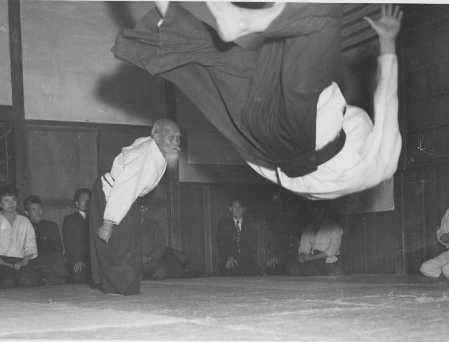 Jay Gluck was a young man trying to make a living as a writer and photographer in Post-World War II Japan. He sold an article on the exotic fighting art of Karate to True magazine and started looking for another equally exciting subject for men's magazines.
He was able to convince a slight old man to perform a filmed demonstration for his article. Gluck secured the assistance of several off-duty Air Force MPs and the use of a few spare Judo mats. The young men were all experienced fighters and athletes with a knowledge of karate and judo, and were even armed with a few bokken. Gluck set up his camera with high expectations.
And his expectations should've been high, because the old martial artist he had engaged for the filmed demo was Morihei Ueshiba, founder of Aikido.
The MPs attacked Ueshiba for several minutes, but never laid a hand on the man. Instead, they broke out into amazed laughter and childlike giggling as they fell over and into each other while Ueshiba danced out of the way.
Later, the editors of True rejected the film as staged. They found it impossible to believe the little old man could keep a group of sturdy young men from easily catching him. They pointed out the MPs often weren't even looking at Ueshiba, and their stupid grins indicated -- obviously -- that they weren't taking the attack seriously.
Gluck, a well educated man, was struck by a Biblical passage during the filming. Luke 4:28, "And all they in the synagogue, when they heard these things, were filled with wrath. And rose up, and thrust him out of the city, and led him unto the brow of the hill whereon their city was built, that they might cast him down headlong. But he (Jesus), passing through the midst of them, went his way." And also John 10:39 "Again they tried to arrest him, but he escaped from their hands." Gluck expressed these thoughts to both a minister who viewed his pictures, and Ueshiba himself. Both men agreed with Gluck, but Ueshiba (an adherent to a splinter Shinto mystic group) claimed, "In learning aiki, you must make yourself pure. He who was already pure, intuitively knew aiki from the beginning."
Jay Gluck wrote a book: Zen Combat, and you can read more about his adventures in martial arts.
Sunday, September 03, 2006
Shogun Assassin
 I started a spat over at Dan Dorman's blog. I asked Mr. Dorman about the proposed Hollywood version of Lone Wolf & Cub a series of Japanese samurai movies. Mr. Dorman was able to inform me, to my dismay, that the remake will be turned into a Western.
 The discussion quickly turned to the first American incarnation of the film, Shogun Assassin. This was a re-cut, re-edited combination of the first two movies in the Japanese series. The plot was garbled. Somehow, the result is still regarded as brilliant. Even with the FM DJ voices doing the dubbing, it does achieve a strange brilliance from the Chinese fortune cookie dialogue, quick cut action, and psychedelic special effects added to the mix.
 The Japanese movies were based on a comic book, or manga, which ran to 26 volumes. They tell the story of how the Shogun's executioner was framed by the shogun's assassins, and the long road to vengeance the excutioner and his son travel together. Blood runs thick through the pages as every (yes, every) weapon in the classical Japanese martial arts arsenal is brought into play. Even though the action always has central place, as the story develops Buddhist theology and philosophy come into play
 One of the things the movie fanatics over at DD said was that obviously the gents who made Sin City saw Shogun Assassin a few times. Well, yes they did. Tarantino references the movie visually several times during both volumes of Kill Bill and near the end of the movie, The Bride watches the movie as a bedtime story with her newly found daughter. She compares her new relationship with the little girl to the Ronin and his child.
 More importantly, Frank Miller -- credited as a co-director for Sin City, and author and artist of the comic book originals -- has been a huge fan of the Lone Wolf and Cub Manga since the early Seventies when a friend thrust them into his hands. Frank couldn't read a word of Japanese, but he devoured the art and the influence on his drafting style is obvious any time you lay the two side by side. In the perfect storm of the late seventies and eighties, Frank's Japanese obsession meshed with other cultural imports from the Asian archipeligo. Frank gave us the ninja assassin Elektra, her nemesis the Hand, and soon ninja were everywhere in comic books: Wolverine, GI Joe, the spoof Teenage Mutant Ninja Turtles which further morphed into a "serious" series... All directly influenced by Lone Wolf and Cub. Ninja became a household word partly because of Frank's efforts.
I have the first two movies in the LW&C series on DVD, and the last movie on Video tape. I also have the complete run of LW&C manga which Dark Horse Comics finished publishing about three years ago. You can actually find the LW&C manga in your local Borders, assuming you can step over the teenage girls who sprawl in the manga aisle so they can giggle over the romantic manga. And of course, I recommend all versions without reservation. Lone Wolf & Cub in any format is a towering achievement of imagination.
Subscribe to:
Posts (Atom)