I had an interesting experience as a martial artist this week. I was walking out of a meeting alongside my boss. In the waiting area sat a familiar looking man who stood when he saw us. My boss, who knew him, said hello. Then the man asked, "Tough meeting?" "Not really," she said, "Why?"
"Well, you brought your bodyguard with you," he said. My boss was perplexed at this point. "He's dangerous," the man said, "I've seen him in action." I was laughing. I'd figured out that the man was the father of one of my fellow students at the dojo. But my boss didn't even know that I was a martial artist. The gentleman's comments were both pleasing, and a little embarrassing for me. It's always flattering to be recognized for one's abilities, but it's even more important to have self-recognition of the limits of those abilities. So when this gentleman called me a "master" and bowed (!) to me, I had to put a stop to it all.
Humility is a virtue most people expect in a modern martial artist. However, it's not something we always get. Anyone remember the ruthlessly glory seeking Cobra Kai dojo in
The Karate Kid? Have you seen the pro-wrestling-like spectacle surrounding the entrance of a Mixed Martial Arts competitor as he heads to the ring? Howabout the hype in the martial arts fan magazines ads for training videos? ("Kill
ANY man
instantly with these FIVE devastating, secret techniques!!
I can tech you!!!") No matter, most people expect martial artists to be humble about their abilities.
humility of a somewhat different kind was expected of the classical warrior. And the frankly fawning experience I had reminded me of an old story.
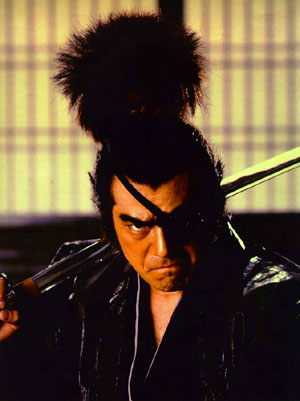
Yagyu Jubei was the scion of the Yagyu family of swordsmanship instructors to the Shogun's family. The Yagyu family had developed a school of swordsmanship over the course of three generations, and it was renowned as a particularly effective method with several secret techniques. Even at a young age, Jubei was a true master and understood the distance and timing that spelled the distinction between life and death for a samurai swordsman. His skills were in much demand as an instructor, and no matter where he went, his reputation preceded him. The following story is the version recounted by Wayne Muramoto, a leading U.S. martial arts writer and a student of the Takenouchi Ryu:
Jubei was at a daimyo lord's estate when a masterless samurai, or ronin, managed to enter the domicile and requested a match. The two met with wooden swords. Two matches were played out before the daimyo.
At the end of the second round, Jubei turned to the swordsman and said, "Well, did you see the results of the match?"
The ronin said, "Of course, it was a tie (ai-uchi) both times!"
Jubei then turned to the daimyo and said, "Did my lord see the true results?"
The lord replied, "As the ronin said, they were both ties."
Jubei was disgusted, and told them that they were too inexperienced to see the actual outcome of the duel.
Angered, the ronin demanded a rematch, this time with real swords.
"It would be a good idea to stop asking for something unreasonable," Jubei replied coolly, but anger flickered in his own eyes. "You don't have two lives, you know."
The ronin kept pressing for a rematch, however, thinking that by decisively defeating Jubei he would secure his own fame. Finally, Jubei assented.
"Let it be on your own heads, then," Jubei said, passing a freezing glance at the daimyo and the ronin.
The two again met, this time with real swords, in front of the daimyo. The ronin attacked Jubei with the same technique he used in the previous two matches. However, Jubei's sword sliced quickly through the ronin's shoulder before he could utter a second kiai, or shout, and the swordsman toppled in a crumpled, bloody heap before the stunned daimyo.
Jubei was also touched by the ronin's sword, but the sword had only cut slightly through his kimono. Jubei had timed and distanced himself perfectly, something neither the daimyo or the hapless ronin were able to understand in the previous matches with wooden weapons.
"Please verify the match," Jubei said to the daimyo."Look at this dead man. True swordsmanship is a matter of a hundredth of an inch. You should have seen that in the previous matches and ruled it as such. This death was a senseless one."
That's the story. Modern readers are accustomed to humility being expressed as I did, in an exchange of: "You're the greatest." "No, no please; I'm just me." "Really, you're the greatest!" "Please stop, I'm not all that." "Truly, you are." etc., etc. It's sincere, but something of a self-mockery at the same time.
Jubei, on the other hand, lived in a world where reputation, experience, and actual skill all existed in a potentially deadly balance. Humility is a different concept in such a circumstance. Humility exists here in choosing the correct action. Jubei had several choices in the story. He could've ignored the ronin -- but to ignore too many challenges raised the specter for others that he was a coward. He could've completely thrashed the ronin in the first match, possibly even crippled him in a one sided encounter. Instead, he attempted to subtly overmatch the ronin, and respected him by allowing him the chance to see and admit his loss. Even when the threat escalated to live steel, Jubei allowed everyone else the option to back out of the match. The ronin forced Jubei into revealing his full skill in a decisive encounter; at that point Jubei's personal honor, his family honor, and even the honor of the Shogun was at stake. Given the time and place, he had no choice.
We might read this story and see an act of arrogance in Jubei's annoyance that no one appreciated the subtlety of his skill. We might even believe that Jubei won the encounter by killing the ronin. But I read this and see a man who fought reluctantly and with great humility. In the aftermath, he must have felt defeat having been cornered by circumstance. By recognizing that his martial skill was superb, but that his political skill to avoid the situation was still lacking, Jubei was probably humbled by this defeat and reminded of the long path still ahead of him to mastery.