I've been reading By the Sword, a social history of (mostly western) swordsmanship by Olympic fencer Richard Cohen. Mr. Cohen has an obvious passion for his subject and has undertaken extensive research, but his experience has clouded some of his perceptions of the subject.
For one, he seems to believe that Western swordsmanship has been a constant evolution towardsthe modern fencing form. This is true from a sporting perspective. His underlying thesis seem to be that western sword technique transitioned from the inelegant, haphazrd "hack and slash" to the elegant, focused thrust of the point, the essence of which has been distilled to modern fencing.

To be fair, Cohen is of two minds, and mouths a few platitudes. At one point he accurately quotes the noted expert Ewart Oakeshot on the fact that medieval swordsmanship had art. But he quickly dismisses the medieval form as unschooled and lacking in subtlty. The medieval form's greatest sin is that it lacks the complictaed and extended "phrases" that make up modern sword exchanges. Later, Cohen admires the Renaissance development of the rapier, and the corresponding emphasis on the thrust. But then he decries that rapier fighters still circled each other rather than fight in the straight lines of modern fencing.
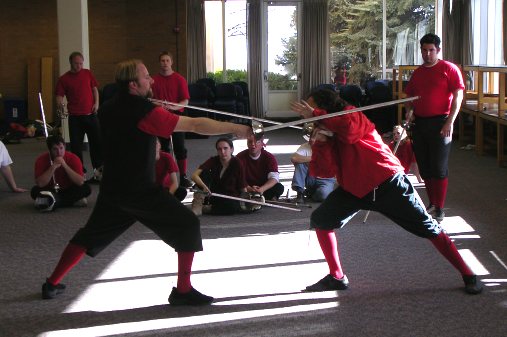
There is plenty of evidence that medieval swordplay featured a great deal of technique, strategy and even subtlty. However, these characteristics emerge not in the intimate caresses of the blades, but in the totality of the fighting. The sword and shield fighter concerned himself with angling, distancing and manuervering. It was necessary to draw out the opponent into an overextension, or the opening of a vulnerable line to cover a feint attack. Medieval fighters, of course, usually had to worry about their environment and almost always had to deal with multiple opponents, very different from modern fencing.
The same is true of Renaissance fighters, who may have dueled one-on-one more often, but still fought their rapier combats in crowded streets strewn in garbage. Anyone who has studied or experienced actual combat understands why rapier duelists might circle each other in an attempt to gain advantage.
 Moreover, swords change according to many conditions, but not because they are evolving toward a perfect pointy form of epee or foil. Cohen includes a section on sword metallurgy but fails to follow through on the interaction of technology with swordplay. He does explain that limited as they were to soft metals, the ancients used shorter swords. (He does not mention, strangely, evidence of a long rapier-shaped sword used by the Mycenean culture that fought the Trojan War.) But other factors contribute to sword shape, so he is mistaken in lumping the Roman gladius in with these soft metal short swords. The short gladius was intentionally kept short for tactical reasons. Roman close order drill trained the infantryman to fight in a well-armored line, stabbing and hacking at the enemy with a chainsaw-like effect. Against Greek adversaries, the dismembering results were demoralizing. Celtic and Germanic adversaries were unable to bring their longer swords to bear against the crowded line.
Swords of medieval times were well made status symbols among the elite knights, but they were secondary weapons on the field, to be used to slash lighter armored infantry from horseback after the lance was used in the initial charge. Early medieval swords emphasized the slash, and were made to hew through mail. The cycle of battle technology created improving defenses and the elite medieval warrior incorporated metal plates as armor. Swords did change to incorporate a more defined point to thrust through open gaps, but increasingly the weapon of choice against a plate armored opponent was a bludegeoning tool such as a mace, hammer, axe, or morning star. The sword was still mainly reserved for slashing the light infantry.

In tournaments, were the sword was still used against opponents in heavy armor, it grew in size, and was typically blunter. Compared to the lightning quick exchanges of a modern fencer, these duels did seem slow and ponderous. But the medieval armorer knew his craft, and even a heavily armored warrior was surprisingly nimble. The fighter used his whole body to propel the sword and avoid incoming blows. Tournament fighting caused deaths, but generally this was a battle against exhaustion as one fighter battered his opponent into submission.
The rapier did not emerge because the thrust of a point is "better," which is a subjective term. It appeared because there was need for a light (and even fashionable) defensive weapon for an emerging, town-based middle class. These people fought unarmored, and the quick thrust had certain advantages of speed. Rarely, however, were rapiers taken to the battlefield, and swords with heavy, broad blades continued to exist alongside the rapier for centuries. A bastard form, usually called a "cut and thrust" sword also existed though it lacked the speed of the rapier and heft of a battle sword.
When widespread firearms were introduced during this period, swords changed again as their use changed. Small swords emerged as fashion accessories and last ditch self-defense weapons. These are almost vestigial swords. Sabers, on the other hand were heavy military blades with a form useful to cavalry troops who still charged into infantry formations and broke them with shock and slashing attacks. For private duels, the weapons still tended to be heavier than everyday civilian counterparts, but were generally not as heavy as military swords.
Modern fencing is built on the techniques that developed in this last era of combat swordsmanship. However, it has taken on distinctly sporting habits. A sliding grip to extend the reach for a sly point is a common technique with sporting application, but nearly useless as a serious combat technique. The swords and their techniques are elegant, and the phrases exchanged during a conversation of blades is a beauty to watch. However, a long ago combatant would probably sneer at the foppery of entangling blades for extended periods when you might need it to ward off a second opponent.
I still recommend the book to anyone interested in the history of swordsmanship. But keep a close eye on the author's prejudices. They are as interesting a story as any he tells.


 John Fusco is the writing "genius" who brought you Emilio Estevez as Billy The Kid in both Young Guns and Young Guns 2. He's been tapped by a major Hollywood production company to update another old classic.
 Zhang Ziyi is the flower of the Orient who has starred in such classy films as Crouching Tiger, Hidden Dragon. She also managed to overcome her Chinese-ness to play a Japanese woman in Memoirs of a Geisha. A stretch that should've earned her an Oscar by Hollywood standards.
 What these two facts have in common is this: The Seven Samurai. John Fusco has been tapped to write, dare I say "update," a Hollywood, big budget remake of the Akira Kurosawa classic from 1954. Zhang Ziyi has been asked to star. The tentative release date is 2008.
 I expect to be following this development pretty closely. Do yourself a favor, if you haven;t already, and see all four wonderful hours of the original. It's a long time to watch a subtitled, black and white movie, but it is so worth your time if you love film -- even if you have no interest in "samurais" and "ninjas."