Wednesday, June 07, 2006

Extreme HALO Jumping


The Wing. And the future practical use of the wing...

One line of trouble...

Enjoy.

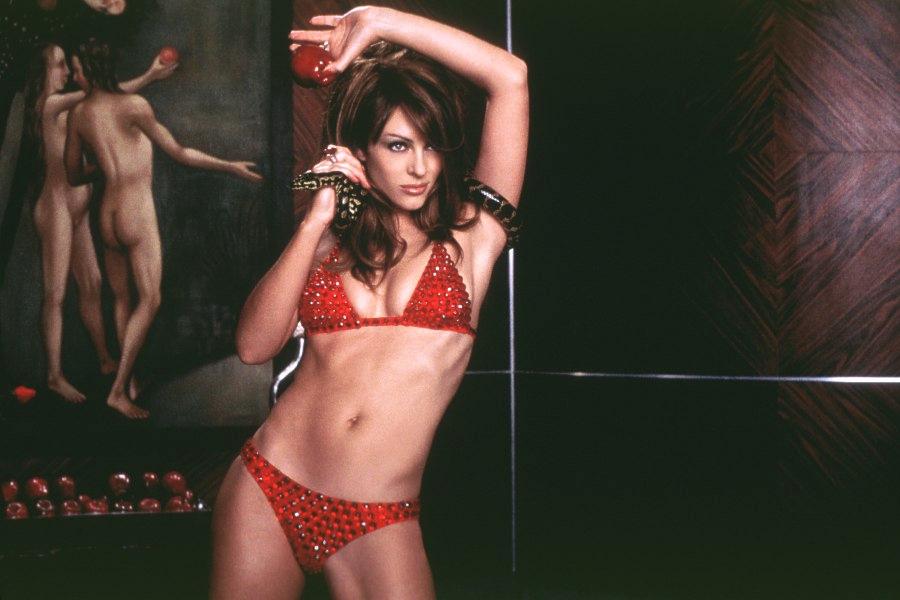
Who Couldn't Use a Little More Elizabeth Hurley in the Lives?

Greetings, fellow survivors!

Well, yesterday was the Day of the Beast: 06/06/06. Fortunately or unfortunately, the devil didn't make a grand entrance -- appearing as Liz Hurley or otherwise.
In fact, I'd venture to say that yesterday was about as ordinary a day as I've seen come and go in a long time. No waters turning into blood. No plague of frogs. No locusts. No great stars falling from the sky's firmament.
This guy -- who is most definitely not Liz Hurley -- is Anton Szandor Levay, author of the Satanic Bible and founder of the Church of Satan back in the sixties. He's dead now, so presumably he knows whether or not he threw his hat in with the right crowd. he was one weird dude, but his version of Satan worship ran towards more uninhibited orgies and zero on the sacrificing of babies, or even black cats.
One of my favorite recent depictions of Satan was in Mel Gibson's Passion of the Christ. An Aramaic-speaking, androgynous fallen angel with a (forked) gilded tongue was very creepy. Even if he did dress like a rejected Sith Lord design from George Lucas' studio.

On a brief -- serious -- note: One of my favorite explanations for Satan's fall appears in Arabic thought. They say that when God created man, He recognized man as the pinnacle of all creation and commanded all His other creatures to bow before Man. Lucifer, loving God most of all, refused to bow before another mere creature because he reserved his reverence for God alone. For this impertinence, God cast the devil out of Heaven. It's a tragic story. I like the story because it has layers of meaning. The more you think about it, the more subtleties you can draw out. There's the tragic irony that it is the Devil's love which ultimately cuts him off from God. The arrogance normally attributed to being the Devil's downfall is there too: the Devil dares to second guess God's command.

But we can't be serious all the time. Take this guy. Is he really flashing the "sign of the devil?"
Must be, he's doing it on two different occassions. Doesn't he have enough trouble without being accused of being in league with the Devil?

Of course, everyone has photoshop these days...

Wednesday, May 31, 2006

Heretics! The Legio Bolter and Chainsword will purge you!

First Time Ever! Blue Prints for a Cloak of Invisibility!

And now, for the first time ever! I will reveal the ancient ninja secrets and provide you with the secret blueprints for a cloak of invisibility. Please study them carefully:


And that's how to do it folks. Use this arcane knowledge wisely.
(Yes, this was revealed to me by the great Ashida Kim.)

Sunday, May 28, 2006

The Tracker

I recently had the opportunity to try out the Tracker knife from TOPS Knives. This knife was designed by well-known survival instructor, and Friend to the Earth, Tom Brown and was also featured in the film, The Hunted. Yes, it looks like a Rambo Knife's worst nightmare. The Tracker is designed to act as a survival knife, axe and hammer all in one. TOPS Knives are advertised as being made for the "spec ops" community. I have no idea how many of our spooky protectors are actually carrying these monsters, but the knives sure are cool.
Despite the knife's ungainly, top heavy appearance, the Tracker is surprisingly well balanced and is as good at hacking stuff as you would imagine. The blade coating held up amazingly well as we put it through some pretty abrasive target material. I have no good idea what the top-of-the-blade serrations are; speculation ran from them being sawteeth to wire cutting notches. We didn't try sawing anything, but it didn't look like that would be an easy task. I could see wire-cutting, but it seemed odd there would be more than one notch, and I wasn't sure what survival situation would call for that feature regularly enough to warrant wire cutting notches. The handle is made of micarta and was extremely comfortable even when held in several types of grip. As we cut through milk jugs, the micarta became wet, but lived up to its reputation for staying tacky to the touch. No slippery fingers here. The handle was also purposely designed to accommodate different drips for different survival tasks.

The sheath is the current standard kydex/thermoplastic. It is as well-made as the knife and holds the blade very securely in place. It feature two rotating, clipping belt loops allowing for many different modes of carry. The flat-across the small of the back view shown above has serious cool factor to it, and looks very hardman. The sheath also had a slot for water drainage.
This is not a knife for everyone. And at $250-$400 (depending on your retailer) not everybody can have one. But it definitely gives its owner serious bragging rights when it comes to "Who Has the Coolest Toys" discussions.

Wednesday, May 03, 2006

School's Out For Summer


I promised this for one of my regular readers.

Wednesday, April 26, 2006

Fall Black Belt Demo Redux


Dojo Mates! Do not forget that we are still discussing options for a Fall Black Belt Demo. Please continue the discussion in the comments section of the original posting.

For those of you looking for that post, use the list on the lefthand side of the page to navigate.

By the Sword

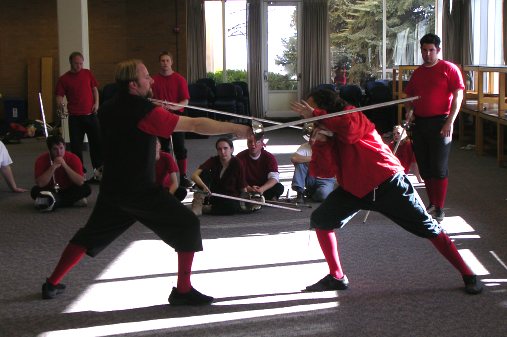
I've been reading By the Sword, a social history of (mostly western) swordsmanship by Olympic fencer Richard Cohen. Mr. Cohen has an obvious passion for his subject and has undertaken extensive research, but his experience has clouded some of his perceptions of the subject.

For one, he seems to believe that Western swordsmanship has been a constant evolution towardsthe modern fencing form. This is true from a sporting perspective. His underlying thesis seem to be that western sword technique transitioned from the inelegant, haphazrd "hack and slash" to the elegant, focused thrust of the point, the essence of which has been distilled to modern fencing.
To be fair, Cohen is of two minds, and mouths a few platitudes. At one point he accurately quotes the noted expert Ewart Oakeshot on the fact that medieval swordsmanship had art. But he quickly dismisses the medieval form as unschooled and lacking in subtlty. The medieval form's greatest sin is that it lacks the complictaed and extended "phrases" that make up modern sword exchanges. Later, Cohen admires the Renaissance development of the rapier, and the corresponding emphasis on the thrust. But then he decries that rapier fighters still circled each other rather than fight in the straight lines of modern fencing.

There is plenty of evidence that medieval swordplay featured a great deal of technique, strategy and even subtlty. However, these characteristics emerge not in the intimate caresses of the blades, but in the totality of the fighting. The sword and shield fighter concerned himself with angling, distancing and manuervering. It was necessary to draw out the opponent into an overextension, or the opening of a vulnerable line to cover a feint attack. Medieval fighters, of course, usually had to worry about their environment and almost always had to deal with multiple opponents, very different from modern fencing.

The same is true of Renaissance fighters, who may have dueled one-on-one more often, but still fought their rapier combats in crowded streets strewn in garbage. Anyone who has studied or experienced actual combat understands why rapier duelists might circle each other in an attempt to gain advantage.

Moreover, swords change according to many conditions, but not because they are evolving toward a perfect pointy form of epee or foil. Cohen includes a section on sword metallurgy but fails to follow through on the interaction of technology with swordplay. He does explain that limited as they were to soft metals, the ancients used shorter swords. (He does not mention, strangely, evidence of a long rapier-shaped sword used by the Mycenean culture that fought the Trojan War.) But other factors contribute to sword shape, so he is mistaken in lumping the Roman gladius in with these soft metal short swords. The short gladius was intentionally kept short for tactical reasons. Roman close order drill trained the infantryman to fight in a well-armored line, stabbing and hacking at the enemy with a chainsaw-like effect. Against Greek adversaries, the dismembering results were demoralizing. Celtic and Germanic adversaries were unable to bring their longer swords to bear against the crowded line.

Swords of medieval times were well made status symbols among the elite knights, but they were secondary weapons on the field, to be used to slash lighter armored infantry from horseback after the lance was used in the initial charge. Early medieval swords emphasized the slash, and were made to hew through mail. The cycle of battle technology created improving defenses and the elite medieval warrior incorporated metal plates as armor. Swords did change to incorporate a more defined point to thrust through open gaps, but increasingly the weapon of choice against a plate armored opponent was a bludegeoning tool such as a mace, hammer, axe, or morning star. The sword was still mainly reserved for slashing the light infantry.

In tournaments, were the sword was still used against opponents in heavy armor, it grew in size, and was typically blunter. Compared to the lightning quick exchanges of a modern fencer, these duels did seem slow and ponderous. But the medieval armorer knew his craft, and even a heavily armored warrior was surprisingly nimble. The fighter used his whole body to propel the sword and avoid incoming blows. Tournament fighting caused deaths, but generally this was a battle against exhaustion as one fighter battered his opponent into submission.

The rapier did not emerge because the thrust of a point is "better," which is a subjective term. It appeared because there was need for a light (and even fashionable) defensive weapon for an emerging, town-based middle class. These people fought unarmored, and the quick thrust had certain advantages of speed. Rarely, however, were rapiers taken to the battlefield, and swords with heavy, broad blades continued to exist alongside the rapier for centuries. A bastard form, usually called a "cut and thrust" sword also existed though it lacked the speed of the rapier and heft of a battle sword.

When widespread firearms were introduced during this period, swords changed again as their use changed. Small swords emerged as fashion accessories and last ditch self-defense weapons. These are almost vestigial swords. Sabers, on the other hand were heavy military blades with a form useful to cavalry troops who still charged into infantry formations and broke them with shock and slashing attacks. For private duels, the weapons still tended to be heavier than everyday civilian counterparts, but were generally not as heavy as military swords.

Modern fencing is built on the techniques that developed in this last era of combat swordsmanship. However, it has taken on distinctly sporting habits. A sliding grip to extend the reach for a sly point is a common technique with sporting application, but nearly useless as a serious combat technique. The swords and their techniques are elegant, and the phrases exchanged during a conversation of blades is a beauty to watch. However, a long ago combatant would probably sneer at the foppery of entangling blades for extended periods when you might need it to ward off a second opponent.

I still recommend the book to anyone interested in the history of swordsmanship. But keep a close eye on the author's prejudices. They are as interesting a story as any he tells.

Guests of the Ayatollah


This month marks the 26th anniversary of the Desert One Debacle. For those of you either too young to remember, or old enough that Alzheimer's has set in, Desert One was the landing site for the failed mission to rescue the hostages at the American Embassy in Tehran, Iran.

Mark Bowden, author of Black Hawk Down has written a new account of the Iranian Hostage Crisis called Guests of the Ayatollah which will soon be released. For those of you only interested in the military end of things, the rescue mission segment is excepted in the current issue of The Atlantic, and available online.

Other books detailing the rescue mission include Delta Force by Charlie Beckwith, and Inside Delta Force by Eric L. Haney. Harder to find is The Guts to Try by James Kyle.

Yes, Mark Bowden has sold the movie rights to this book too. Who will play Chargin' Charlie?

Jamie Lynn DiScala


Hey. HEY! What you lookin' at? Just keep goin' if you know what's good for ya.

But are they still wrong half the time?


My interest, bordering on obsession really, with special operations forces has been well documented on this website. I've even allowed "Gene Simmons (No relation)" to spoof me about it a couple of times. But my academic interest is true and deep, not just some flighty wannabe-itis. How many of you knew about AFSOC's Combat Weathermen, or Grey Berets?

Sunday, April 23, 2006

Fall Black Belt Test Demo Project


OK, so I'm looking for some serious input from some of my "dojo-mates" who read this site.

As you know, next week will be the Spring Black Belt test. For the past several black belt test cycles, I have been saying that the advanced class ought to get our act together and plan a demo for the next test.

I think the time has come.

So the input I'd like first is you ideas for a demo. I'm willing to accept some humorous ideas in addition to some more traditional ones. But I want a brainstorming session first.

Just to throw a few ideas out there: we could do a live demo or a video. We could do a skit with a storyline, or simply demonstrate some techniques not usually seen outside our class. We could do traditional techniques, for example battlefield weapons, or secret weapons; or we could do modern applications, such as knife technique, or gun disarms. We can dress up in the silly outfits, or wear samurai costume, or BDUs and black fatigues.

But we need some ideas first. Then we'll worry about the logistics and practicality and time and who partcipates. So I'd like to see some suggestions filling the comments section of this posting. I'll take suggestions for a few weeks, and then we'll move onto the next logical step.

Everyone cool with that?

For Gene Simmons (No Relation)

Beauty and the Beast

OK, so I was riding around in the gas-guzzler yesterday when my wife stuck in one of her new CDs. It's all sixties covers, and I was less than enthusiastic, but at least it wasn't Sixties British folk. (And, I decided long ago that as a man who still regrets not replacing his Poison cassettes with CDs, I have no right to criticize someone's taste in music.)

But then I realize, gee those voices sound familiar; so I asked. It turns out that Matthew Sweet and Susanna Hoffs (yes, of the Bangles) cut this album, called Under the Covers (Vol. 1). So in an idle moment of curiosity at a stop light, I check out the liner notes to see how Susanna Hoffs looks these days.

Hey, I'm a man, baby. What do you expect? At least I'm honest about it.

Well, she looks great (see above photo). So here's a shot of the two singers together; not from the album stills, but it gives a good idea. Ready? Here goes:

Look at him. What a disgrace. He looks like he's just come home from the custom motorcycle shop where he's been artistically redesigning choppers all day. At least his hands aren't covered in black grease. Think it's just a bad shot? Think again:
At least he shaved for this performance. Look, I'm no Adonis, but I stay neat. I just don't know what to think. Except that maybe, in the words of a great philosopher, "I should've learned to play the guitar. I should've learned to bang them drums. That ain't workin'. That's the way you do it. You get your money for nothing and your chicks for free."

Anyway, here's another shot of Ms. Hoffs. I wouldn't want to leave you with Mr. Sweet on your mind and give you nightmares...