Sunday, April 20, 2008

Tactical Force TF16

Sorry that photo is so blurry. This is the Tactical Force TF16 I purchased last Sunday. The TF16 is an airsoft M4. Airsoft guns are a type of air gun. They shoot 6mm plastic pellets at relatively low velocities.

The quick history on these is that extremely strict firearms laws in Japan lead to a demand among "fans" for extremely realistic replicas of military guns that could be used for some kind of target practice. It was a short leap from shooting paper to shooting people, and now these things are used in elaborate games of tag, much like paintball. However, the nature of realistic airguns has pushed these games of tag into military simulations. And some military and law enforcement groups have latched onto the technology for force-on-force training.

Mention "force-on-force" training, and I get interested. So when I saw one of these babies in a local sports equipment store, I started salivating. The TF16 is an "AEG" or "automatic electric gun." It uses batteries to drive gears that run the air chamber. This can be done fast enough to allow a rapid rate of fire -- the TF16 is rated for 900 rounds a minute. All you have to do is hold down the trigger.


Full auto anything sounds like fun to me, but the TF16 is priced at $129.99, so I didn't snatch one up quickly. Instead, I went to several competitor stores to see what kinds of airguns that had, and what the prices were. You can imagine that a realistic looking airgun makes lots of people nervous, so most other stores had clear, plastic-cased guns. Other guns weren't AEG, but spring loaded one shot at a time. So if I wanted a gun that looked like a real-deal M4, the TF16 looked like it. I also knew the store put the airsoft guns on sale from time to time. So I waited a couple of weeks until last Sunday's flier indicated a 25%-off sale.
Once I'd finished my comparison shopping, and the sale was on... I was ready to buy my very own AEG!


The TF16 is superbly detailed in every respect. It's 1/1 scale. The stock extends. It includes accessory rails. The sights are fully adjustable. And it includes a replica "red dot" sight.


The instructions told me the batteries needed to charge between 2 and 6 hours. So I had to wait a little while before being able to try out my new air gun. In the meantime, I set up my basement target range. I jerry-rigged a target and trap. I'd be able to shoot the paper bullseye, into a net, and the pellets would drop into a bag.
Then I figured out how the magazine worked. This was fairly complicated, since you had to crank the springs in the magazine until the BBs were in place.


Once I was fully-charged, I turned on my red dot sight and slapped my magazine into place. Then I pulled back the charging handle above the pistol grip and clicked the selector switch to "semi." I was ready to rock and roll!


A few shoots later, I was hooked. Everything was working great. The red dot sights were awesome! It took me a little getting use to it. But I was able to keep both eyes open and put the red dot right on top of my target. Best of all... the BB went right where I wanted it.

At that point, I switched the selector to full auto. I pressed the trigger and cut loose with 900 rounds of BB fury! I was able to shoot out the center of my target. The shot groups were extremely tight at 20 feet on full auto.

This was heaven! Full auto fun right in my very own basement. And the sound was no worse than a typewriter. (You remember those, right?) Of course, on full auto, the magazine ran dry quickly and I had to reload.


I reloaded the weapon and started shooting again. Then I noticed that holes were no longer appearing in the paper target. I fiddled with the magazine again, and even went back to semi-auto fire. This time, the sound in the gear box changed form a stiff "whiff" to a dull "whaff." The air was no longer being directed out the barrel of the gun, but escaping out the sides of the air chamber.
My airsoft gun was defective. Talk about feeling deflated! My shooting session hadn't lasted 40 minutes. So, despite my big fun, I'm giving a hearty two-thumbs down to the Tactical Force TF16. Don't buy one! On the bright side, I was able to return the rifle to the store without a hitch.

What have we learned? Well, if the cheapo red dot sight on a crappy air gun worked this well, I can only imagine a real red dot sight works much, much better. So I'll be saving some pennies to add one for my real rifle. Second, airsoft guns don't like me.


Wednesday, April 16, 2008

X-Files 2: I Want to Believe

Today we learned the title of the new X-Files movie: X-Files: I Want to Believe.

It took me a little searching, but I found this video which appears to be genuine leaked footage from some geek fest held somewhere... (I wonder if Olivia Munn attended?)

Here are a couple of other movie bones to throw you. I hope you enjoy...

Olivia Munn on YouTube...

Attack of the Show, starring Olivia Munn, and some other guy (and who really cares about his name?)

Chuck

"If you need a ceiling painted, a chariot race run, a city besieged, or the Red Sea parted, you think of me." -- Charlton Heston, 1924 - 2008

Demo Dick the Sharkman of the Delta

All this digging through my boxes of action figures led me to uncover my 1/6 scale Richard Marcinko. Dick is the founder of SEAL Team 6, a convicted felon (don't mess with federal acquisition law!), and creator of the Rogue Warrior book series. This last is perhaps the least surprising, because he is notorious as a tall tale teller.

I've met Mr. Marcinko, and he even signed my copy of his biography. Actually, he ruined my first edition hardcover by personalizing the signing -- that's a big no-no. Signed copies are much more valuable if it is just the author's name, or name and date. Oh well, I'll never sell my copy so it doesn't really matter.

Anyway, toy maker BBI came out with a Dick Marcinko/Rogue Warrior action figure several years ago. They made at least two versions, one in black ops type uniform -- and seen here -- the other a combat swimmer. I have one of those too... But I can't seem to find it right now.


The other black ops SEAL seen here "training" with Dick is BBI's "Owl."


Here's a shot of Dick in his natural element... Not for nothing was SEAL Team 6's unofficial motto "WGMATATS."
Yeah... I'll let you figure that out for yourself.


Sunday, April 13, 2008

Hidden Leaves

In Neil Gaiman’s Sandman comics, Death is a goth chick. She’s also the friendliest of a pantheon of anthropomorphic personifications called The Endless. And why wouldn’t Death be friendly? She’s got the worst customer service job in the universe, and anyone who’s ever done customer service can tell you that being friendly is the key to success. But Neil Gaiman’s Death is friendly because: a.) Death isn’t exactly what you’d expect, and b.) Death is someone you want to meet.

Our dojo recently experienced an unexpected death among our students. EB, a bright, attractive, energetic high school student was a casualty in a car accident. Her brother, who was driving, fell asleep at the wheel and ran off the road. According to reports, EB was wearing her seatbelt, and her brother was not under the influence of any drugs or alcohol. Except for – and “hindsight-is-20/20” here – the poor judgment of driving tired, no one did anything wrong. It’s fair to say most everyone drives tired once in awhile, and it literally could’ve happened to anyone.

There is a large population of teenagers in our school. More important to keep in mind, most of them started young and literally grew up together. EB had been with us since Second Grade. News of her death spread quickly, and young people don’t take news of this kind very well.

I remember the first few of more peers who died. Unnatural causes, of course. Accidents and suicide are the leading cause of death for people under 18. In these cases, they all did it to themselves – intentionally or unintentionally; suicides and overly risky behavior. Maybe that was easier for me to take because the circumstances were less random, but it didn’t make it easier to accept.

The “last” person to go in this phase of life was one of my closest friends. Craig popped pills and booze while partying – underage – at a dive more or less across the street from our old high school. He missed a turn on the road home, a route he’d traced probably every day of his life, and kept right on going through a heavy wooden fence.

I took a day off school to attend the funeral and returned to college to write an overdue paper on Aristotle’s philosophy of friendship. I poured my grief into that paper; I was crying as I wrote it.

It barely passed. The professor’s red inked note was, and I’m paraphrasing here, “Get over it.” Philosophers aren’t much for sympathy in cases like this. Not that the prof was completely lacking in compassion: she didn’t fail the paper.

You don’t write philosophy under the undue influence of emotion. And the prof was right: death isn’t that hard.

So when I found myself talking to a distraught young dojo-mate on Monday night, I had to remind myself what it was like, and that philosophy was not what he wanted to hear. So I nodded sagely and expressed my sincere sympathies as he rhetorically asked the existential questions about what the tragedy of young death really means.

Honestly, death isn’t hard. It’s a friendly goth chick who dusts you off, explains what happened, and escorts you on to the next big thing – whatever that is, and I don’t want to get into that right now. For the dead, death is easy.

Life. Now, life is friggin’ hard.

A few weeks further into the syllabus on Aristotle we were taught about virtue. To summarize: it’s the choice to do right instead of wrong. It’s moderation, not over indulgence. It is understanding our duties and meeting them. And it is a never ending struggle in these areas – until you die. You can never say, "I’m a good person," until you have the bookend pieces to examine the evidence. Because until Death says, “Hey, honey…” you can throw it all away in the next poor choice.

This is a sentiment almost every martial artist hears at some point in their career when they hear the quote: “The Way of the Samurai is found in death.” This can sound very morbid, or terrifying, or impossibly “hard man” the first time you hear it. It is a quote from the Hagakure, by Yamamoto Tsunetomo, and it is probably one of the most misunderstood quotes in martial arts.

Often it is interpreted to mean that the martial artist should move through life constantly aware of danger around every corner, and prepared to meet it. Sometimes it is broadened to mean that we should order our lives in such a way that if death comes for us suddenly, we leave no regrets behind. That’s not too bad. But what does the author of the quote himself say?

“The Way of the Samurai is found in death. Be determined and advance. To say that dying without achieving one’s aim is to die a dog’s death is the frivolous way sophisticates. When pressed with the choice of life or death, it is not necessary to gain one’s aim.
“We all want to live. And in large part we make our logic according to what we like. But not having attained our aim and continuing to live is cowardice. This is a thin dangerous line. To die without gaining one’s aim is a dog’s death and fanaticism. But there is no shame in this. This is the substance of the Way of the Samurai. If by setting one’s heart right every morning and evening, one is able to live as though his body were already dead, he gains freedom in the Way. His whole life will be without blame, and he will succeed in his calling.”

“Set your heart right.” I don’t think this is too different from Aristotle’s teaching that we need to choose virtue at every opportunity. That’s the point of life; and it isn’t always easy because it takes constant choices. “Be determined and advance.” Don’t dawdle on making a choice, be bold and attack life. “He gains freedom in the Way.” Hopefully, the more you order your life and make positive choices, the easier it is to keep making good choices and the fewer tough choices you have to make. And if you do so, when Death comes, your life will have meant something whether you lived 15 years, or 150 years. “We all want to live.” Attack life, choose virtue, and when the goth chick shows up, you’ll be saying, “Not yet, I’ve got too many projects going left unfinished…” Death can be someone you’re happy to meet because you have no regrets, and you’ve left the world better than you met it.

Sure, we’re all sad that EB is no longer with us to join the fun. To hear her close friends and family talk, she lead a virtuous life, and she will be missed. But this is the meaning of a death of one so young: We reflect on the good she did while she was with us. We appreciate the value of the lives around us. We are prodded to do more with the time we are given.

Wednesday, April 09, 2008

Hmmm... JRF's birthday IS coming up next month...

Anyone looking for a hint about what to get me...

T.O.P. Army Fighter

The Military Channel is running a special on the Army's Modern Army Combatives Program (MAC-P) competition next week.

Those of you interested in MMA fights or combatives might find this interesting. This is a meeting point between sport martial arts and real combat technique. I suspect at least one of my readers might find it interesting from a theoretical perspective of fighting arts...

Some "Figures" you'd be interested seeing in action...

What would Snake Eyes be without his girlfriend, Scarlet?

Maybe it's not the comic book outfit, but I think it works pretty good.

For those of you who asked about whether or not I have anything "slutty" for your Barbies... Sure. Check out this part of my Cobra Command contingent. That's a Baroness on the left in the leather catsuit.


Here's a close-up you can print out for your demented fantasies, boys. That head is from one of Barbie's friends and placed on a BBI female body.


This is a BBI action figure of the comic-book character, Shi. It's a stock figure, not a custom.


I hadn't taken my figures out of the display cases or storage boxes for a couple of years until I needed some Snake Eyes pictures for the blog. But you guys must like the photos of my toy collection. I can tell because you comment more about these than on the martial arts topics.
I realize my toy collection must seem a little... odd. That's okay. At least I'm not watching Star Trek videotapes, or hiding weapons in every room of my house. I'm not criticizing; we're all a little quirky around here I guess.
Really, this is nothing. If you want to see obsession, you should visit OneSixthWarriors and check out what other people do with their figures. Most of what you see there are more like model kits than toys. The hobby has come a long way since I sidelined my collection two or three years ago. You might start with this: a "historically correct" ninja custom action figure...


Wednesday, March 26, 2008

More of the Silent Master revealed.

This is one of Hasbro's most recent Snake Eyes action figures, with his sword-brother Storm Shadow.


This is my "semi-custom" Snake Eyes action figure. The base figure is, in fact, a 12" Hasbro Snake Eyes; so the headsculpt was relativly easy. The other parts came from various manufacturers, which I put together to get this effect. The jumpsuit, for instance, is a wetsuit from a SEAL figure. I did have to get some modeling tape to make the Arshikage/I-Ching symbol on the shoulder. I based the figure off the comics... You'll note the simularities between my version, and the movie costume.


Mmmm... More Snake Eyes goodness from the movie... There are some subtle differences between the equipment here and the equipment in the first pic I posted.


Sunday, March 23, 2008

GI Joe fans, there may be reason to rejoice!

This is the official publicity photograph of Snake Eyes from the GI Joe movie. It appears they got this right, at least.

Sunday, March 16, 2008

More Fight Science Episodes...

Special Ops

I've heard of Stewart Smith, a Navy SEAL, before... But they must've dug up Snake Eyes himself for this participant...

A classified identity? Whoa! How'd they find him in the first place?

Fighting Back

Stairwell Attack

Here's some potential Bullshido, let's see what happens when former Navy SEAL Chris Carraci is introduced to a Taser...

Now that the Taser is over, let's go get a drink. Yeah, that's realistic... Who's dumb enough to mess with someone who looks like Bas Ruttan? (Just kidding, I don't think Bas is the point of this.)

Happy 40th Birthday!

That good looking lug on the left is our dojo's very own Fearless Leader (or as my daughter knows him, Doshi-Doshi) accompanied by his lovely wife on the right. Believe it or not, he just turned 40 years old.

Yes, I said, 40!

All that martial arts training keeps him looking young.

Wednesday, March 12, 2008

Oh, I'm glad I found this before I logged off...

Semper Fi, gents...


From the Halls of Montezuma to the shores of Berkeley...


Damn hippies... Show your support for the Fighting Leathernecks and buy yourself a T-Shirt from Sgt. Grit.

Movies

Never Back Down -- Basically, it looks like The Karate Kid for the MMA generation. Nothing innovative, but probably some fun for a couple of hours.

This, on the other hand, is a David Mamet movie called Redbelt. So it's probably reasonably good. It's got some real martial arts star power behind it too. Randy Couture appears, and it looks like one of the fighters might be one of the Gracies. Mamet, who knows his tough guy movies, is a BJJ grappler so he knows the moves. You might also glimpse Tim Allen (Yes, Tim the Toolman) in the trailer too. Don't quote me on this, but I thnk I heard he's a BJJ guy in real life too. I don't know about the movie. It just goes to show you never know who's doing what with their time.

Kung Fu Election

Okay, I am not much of a finger masher game player, but the opportunity to watch my least favorite candidates get beat up is just too awesome not to share.

Be sure to try the training level to learn how things work first.

Kyuzo Mifune

I have to apologize. I name-checked Kyuzo Mifune in a post over the weekend. I should've included a link to his Wikipedia biography for those of you who are not familiar with the God of Judo.

Check out that anecdote at the end of the wiki page. I'm sure you'll note how these two Judo legends stack their opponents like cord wood. But pay very close attention to the fact that Mifune dispatches his share with blows. There was a lot more to Pre-World War II Judo than throwing for points.

How are we to properly judge the giants of today if we don't know the giants of the past? And now, the next time some wiseguy asks who would win in a match between Bruce Lee and Chuck Norris, you can respond, "Chuck Norris, of course. But: who wins a match between Kyuzo Mifune and Rickson Gracie?"

We care about gi care...

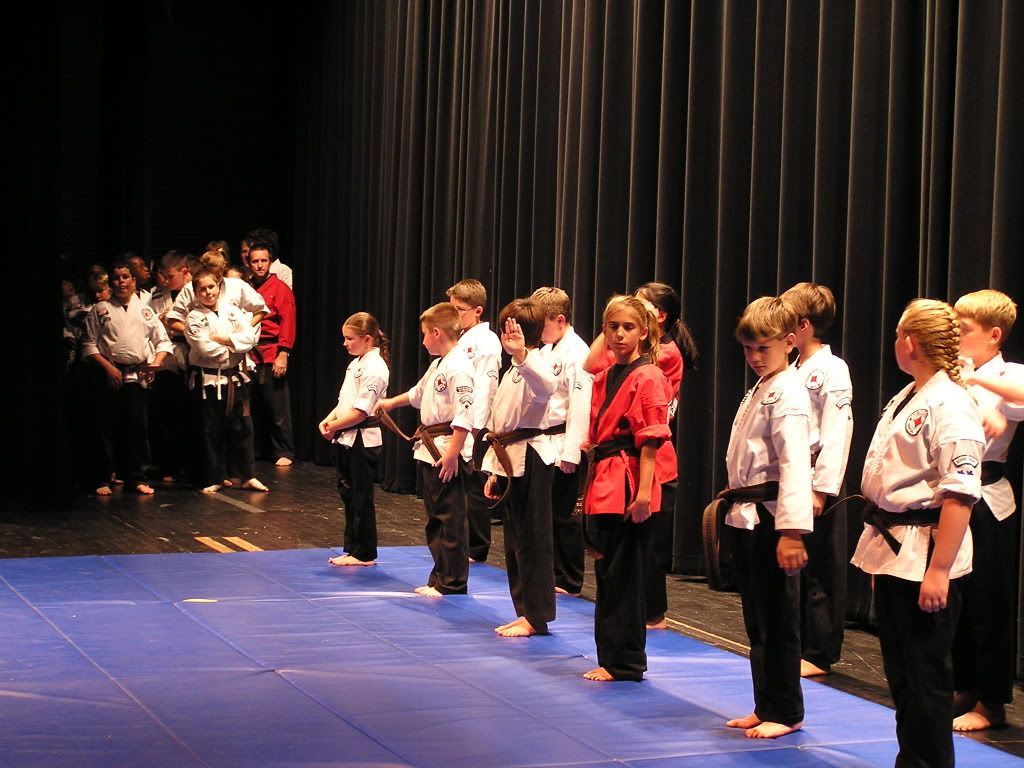
The Japanese martial arts uniform is familiar to just about everyone.

Generically, it is called a keikogi or dogi. Sometimes it is closely associated with the art, hence: Judogi, Aikidogi, or Karategi. Most often, it is shortened to the simple, if vulgar, “gi.”

Does something both simple and familiar even warrant a description? It consists of three parts:
1. the jacket, or uwagi
2. the drawstring trousers, or zubon
3. the belt, or obi – which, of course, has a life of its own.
There are many myths about the origin of this uniform. The best – which is to say both comprehensive and reasonable – is contained in Dave Lowry’s excellent book, “In the Dojo.” Like so many things in modern martial arts, the keikogi is a byproduct of Judo. And while we closely associate the keikogi with tradition, it was as radical in its day as the board shorts and rashguards are in our own day. In fact, the impetus behind the keikogi design was similar. There was a desire for durable, relatively cheap, comfortable clothing that would protect the wearer from mat burn. And if you think traditionalists are incensed today by board shorts, imagine the uproar when Judoka started wearing that very-Western innovation: pants! The horror.

I recently purchased two new gi from Kinjisan Martial Arts, a New York based supplier. These are Ronin Brand gi, which were made in Pakistan. The quality, however, is excellent. I bought a black Judogi and a heavyweight, black Karategi. I won’t give a detailed review of these gi, but I am – so far – extremely pleased with both uniforms. The Judogi in particular, is of amazing quality. When I first unwrapped it, the judogi looked so tough, I thought it might walk over to my Gladiator gi from Asian World of Martial Arts and smack it around for impersonating a Judogi.

But, in addition to suggesting Ronin Brand for your consideration, I wanted to discuss the care and feeding of Keikogi. This is a subject that doesn’t seem to receive much attention these days. I’ve learned my method mostly by trial and error over the years. I can’t swear it is the best, but it works for me.

After unwrapping my two new gi, I immediately washed both twice in a row. I’ve also seen advice suggesting new gi be soaked overnight in water with a modest amount of salt dissolved in the basin. I’ve never tried that, so I can’t tell you about the effects. I’ve always found multiple, initial washing sufficient to soften the material for wear. Nevertheless, the heavy material of a gi doesn’t really loosen up until you start moving around in it. So it always takes a month or so of classes and related washings to work into a gi.

For most of my career, I would wash the go and then throw it in the dryer. For awhile, I even ironed it. Don’t do that. Especially, don’t iron the gi. The material will weaken and fray at the crease. If you do use a dryer on your gi, take the uniform out of the machine immediately when it stops and hang the uniform.

I’ve stopped using the dryer. I now take my wet gi out of the washing machine and hang them up to drip dry. I went out to LinensNThings (or was it Bed, Bath & Beyond? I can’t tell them apart…) and bought heavy duty, metal hangers for this task. Asking the plastic hangers I bought at Wal-Mart to hold a waterlogged Judogi top is too much.

Now my gi are not subjected to the damaging heat of a dryer or iron. Gravity pulls most of the wrinkles out for me, so the uniform doesn’t need to be pressed. I believe this method of drip drying will also help keep my black gi from prematurely fading. With my previous gi, it was too late to tell. I’m watching how long it takes for the new Ronin Brand gi to fade.


Another practice I’m thinking of implementing is buying some nametapes from a military outfitter and sewing them inside my gi jackets and trousers. Obviously, this helps identify your uniform. But if you buy the white tape and a laundry marker, you can also mark your pants and tops in such a way that you can always match the set. That may not be important to some people, but it is to me.

Recently, I purchased some 12oz. cotton canvas from a fabric store to affect a significant repair on an old gi jacket I believe still has some service in it. Fortunately for me, my mother has a professional grade sewing machine for the task I have in mind. Minor repairs can be made by hand, if you have the patience to sew a seam around the edges of a fabric patch. If the patch is small and discrete, the uniform is perfectly capable of soldiering on; if the patch is more obvious, you might want to keep the uniform for informal training sessions. Your uniform is a reflection of your training, and if you train hard, it is perfectly acceptable to have a few dings in the uniform. On the other hand, you don’t want it to be so ratty that you look like slob.
I have slightly more wearable gi in my closet than the number of classes I attend in a week. Generally, the gi will be worn once a week, and washed thereafter. This leaves me with minimal wear-and-tear on my primary uniforms, and still leaves some extra available in case there is a problem or an opportunity for extra training.


I’m not sure why keikogi care is not more widely discussed these days. I guess there is an assumption that people can figure out how to wash their clothes. Cynically, I suspect some schools would like the opportunity to sell you more uniforms more often, so why tell you how to extend the life of the uniform you have? I hope this information helps keep your uniform in good condition. If you have any additional suggestions or care tips, I’d love to hear them.


Sunday, March 09, 2008

Some links

Grappler's Quest

Fight Quest homepage

Judo

Gracie Jiu Jitsu Academy

Kali

For fun: custom ninja action figures

Remember, "Absorb what is useful."

Fight Quest

Sticks and stones may break my bones...

Old news for most...

Sarah Silverman's opening shot...

Her boyfriend Jimmy Kimmel's response.

As he says, this is bigger than the that fat kid with the lightsaber! If you're going to go; go big, and go all the way.

The first Saturday morning class is usually populated mostly by teenage students. Typically, these kids have the overly optimistic view that they know it all. I say that with all due sympathy, for I do remember the confidence of youth. I enjoy observing these kids and training with them because it provides a glimpse into the health of the student body. If they are making mistakes, it is a good gauge that most of the school is making the same mistake and should be corrected. And when they are getting things right… That’s a good sign.

So I note something they got pleasantly correct yesterday morning.

We’ve been incorporating more and more grappling in the Black Belt level classes for just over a year now. It’s been fed at home by watching the various MMA fights. Often you can find the youngsters stretching out on the mat before or after class talking about the fights, and the various BJJ or grappling techniques they’ve seen. Judging from the discussions and what I’ve seen them doing in class, they’ve been very observant. Some of them might even turn into real threats when they finally understand that positioning is more important than the cool chokes and submissions.

Yesterday, two of the young men were talking about arm-locks, and I heard this gem:
“I really like the Kimura and the Americana. You know: they are really the same thing, just in opposite directions.”

Ah-ha! It’s good to see the Black Belt students making these connections on their own. It would be even better to hear them say: “You know -- Onikudaki is just a variation of the Americana…”

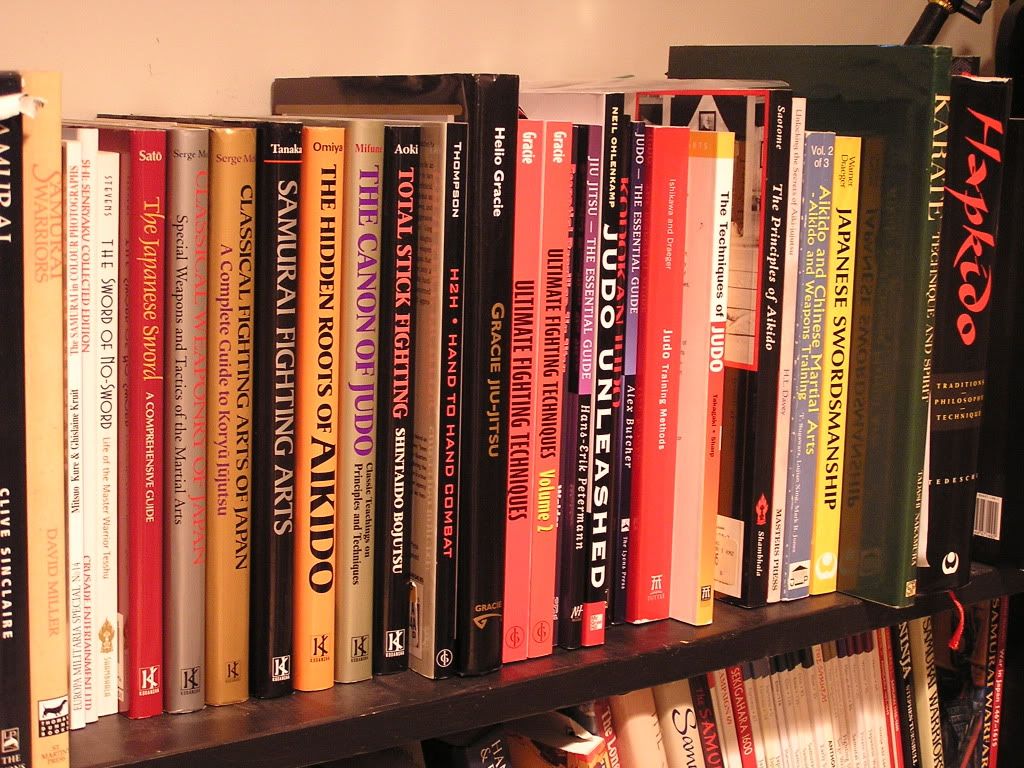
The comment also made me think of some reading I’d done last week in the introduction to Ultimate Fighting Techniques Volume 2: Fighting from the Bottom.

“Royce was not only able to protect himself from Severn’s attempted strikes, but he was also able to submit Severn with the then unknown ‘Triangle Choke.’ From that moment on everyone realized the immense power that Gracie Jiu Jitsu offered a regular human being.”

Advancing in the martial arts means learning to draw connections and see how all the pieces fit together. Often these connections are drawn on the mat, but sometimes you draw them from study in the library. The quote from UFT Vol.2 is most likely from co-author Kid Peligro, a Gracie BJJ Black Belt and spokesperson. It was so overblown in its enthusiasm I had to do a little double-checking and reached for my copy of Kodokan Judo, the standard reference work on Judo technique and practice.

Sure enough, on page 124, I found Sankaku-jime, translation: “Triangular choke.” The photo clearly shows a Judo yudansha with his legs wrapped around an opponent and applying choking pressure to the neck.

I further looked to The Canon of Judo, written by the legendary “God of Judo” Kyuzo Mifune, the last Judo 10th Dan. This was first published in the early 1950’s. On page 154 is Sankaku-Gatame-Ude-Hishigi, or the “Triangular Armlock.” Although the terminology is a little different, the technique looks substantially the same. Except here, not only are you applying pressure to the neck, you are hyperextending the elbow simultaneously. Mifune introduces the technique by saying, “I developed this technique myself, and it always proves effective.”

There is really nothing new under the sun. If you want further proof of that, while you’re checking out Sankaku-Jime in your own copy of Kodokan Judo (you do have a copy, don’t you?), glance over at page 125. You’ll find the Judo armlock called Ude Garami. One named technique, but two different directions you’ll clearly recognize as the Americana and the Kimura…

I don’t really believe Kyuzo Mifune invented the triangle choke anymore than I believe Royce Gracie used it for the first time against Dan Severn in 1995. I suspect it was already ancient when some forgotten Pankratiast snapped his opponent’s elbow and choked him unconscious in the Greek dust to the cheers of his countrymen.

So what lessons are we to draw here? For starters, we need to be looking for these commonalities. It helps us develop and understand our own skills and techniques. It also gives us an appreciation for the efforts of others that we’ve noted in previous postings is sadly lacking. It also saves us some effort by building on work already performed by someone else. Why should we reinvent the wheel?

The Escaping Rat Returns


He Who Shall Not Be Named, or HWSNBN, presented his Togakure Ryu seminars at our dojo recently. His first seminar covered basic information about Togakure Ryu and the Santo Tonko no Gata. The second seminar was presented to yudansha students and covered the kyoketsu shoge, an unusual weapon closely associated with the Togakure Ryu.

HWSNBN began with an informal lecture on various aspects of Togakure Ryu Ninpo. He listed the three special tools of the school:
Senban Shuriken
Shuko, or hand claws; and
Shinodake, a primitive snorkel or breathing tube.

He listed the six traveling tools of the ninja:
The straw hat,
A slate pencil,
Medicine,
A staff,
A fire starting kit; and
A 3 foot square towel

HWSNBN pointed out that it is not the specific tools that are important to us in the 21st Century, so much as the idea that the historical ninja maintained a kit of essential supplies – and was prepared.

He touched on some of the stealth aspects of the ninja, such as various breaking and entering tools, and the clothing. Although just about everyone in America is familiar with the black ninja suit, or shinobi shozuko, HWSNBN explained the limitations of black as a camouflage color. According to him a mid-tone gray, or “maroon” was best. He stumbled over the maroon before eventually saying “rust” to describe the shade he was trying to describe. Personally, based on other sources of information, I think “rust” may be the best choice for the color he is describing.

Then we did kata. HWSNBN did not give a precise, step-by-step on all nine kata. He showed a one-on-one kata, then the kata versus two Uke, and finished with the kata versus four Uke surrounding the Tori. He was far more interested in the proper feeling than the script. At one point he told us that the way the kata are scripted, and even shown on various videos, is NOT the way the shihan show it in Japan. They are not as rigid as the script.

In the single Uke kata, the idea was to match movement with the Uke. Tori needs to be smooth in order not to resist Uke’s pulls. The goal is to avoid adding extra energy to the encounter, but to get Uke to relax and believe he is in control. If Tori adds energy, he reveals his intentions too soon.

A question arose about whether this idea of concealing intentions was related to “mu” or “no mind” often cited in modern martial arts (gendai budo). Shouls Tori have a feeling of mu to avoid adding energy? HWSNBN does not believe it is possible to clear your mind of all thoughts – or you’d be dead. Instead, he says his concept of “still mind” is “don’t anticipate the outcome, and focus on the task at hand.”

[An aside that might be worth your research… Mu is a concept drawn from Zen Buddhism. The Bujinkan schools are connected to Mikkyo Buddhism, not Zen. So “Mu” is really a foreign concept to our arts.]

Another suggestion from HWSNBN is to be less “martial artsy” about the technique. Try to conceal your skills.

The next kata was an unarmed Tori versus two Uke closing in with bokken. The idea is simple enough: Tori needs to maneuver the Uke into position, fix them in place by throwing metsubishi, then escape. Practicing this form required some space, so we took turns doing the kata. I attempted to be Tori early in the session, and I met with limited success. I didn’t get whacked by the bokken, but I didn’t feel as if I owned the situation. I did have an excellent opportunity to observe while others did a far better job as Tori.

This kata is fundamentally the same as sparring against two people. The bokken change the threat and the distance, but it is still the same principles in action.

I did not attempt the four man escape, but watched several others gamely try. Not all were successful. HWSNBN commented that the people who were able to break out of the encirclement all performed some unusual action that caused the Uke to pause. Part of the kata is to use metsubishi to temporarily blind some of the Uke and shuriken to attack the others. HWSNBN was drawing attention to the moment just before Tori throws the metsubishi, the successful ones captured the Ukes’ full attention at precisely that moment, and then disrupted their ability to adjust in the next beat. I’m still pondering what I saw, but I believe this may be the first example of kyojutsu that I have consciously witnessed.


In the evening, the yudansha among us were treated to a special session on the kyoketsu shoge. HWSNBN explained the weapon’s various parts: a hooked spearhead broken off a shaft and modified into a dagger, a heavy iron ring, and a connecting rope. He showed a “secret” method of retaining the dagger end; which, like most martial arts secrets was mostly common sense.

He basically said the shoge was not one of his favorite weapons, and believes it is primarily of historical value. Nevertheless, we were all paired off and sparred shoge versus a shinai. HWSNBN had given some one sentence advice about using good taijutsu which I tried to heed. It seemed to work, and I discovered that if I kept good distance, and didn’t twirl the weighted end so that it was constantly ready as a threat, I could be pretty successful with the tool. Glancing around, I could tell everybody who had trouble wasn’t using distance to their advantage and didn’t understand that twirling the weight gave up timing to their opponent.

One of the themes HWSNBN wove through both seminars is his understanding of the ninja imperative: “I must do whatever is required to keep my enemy from learning my identity and escape.” If the enemy does learn your identity, then you and your entire family will be killed. It is absolutely critical that they do not learn who you are. Interestingly, in the variations of the single person kata, I found it was often possible to move in such a way that your face was not fully visible to the Uke. Escape was always emphasized in the kata. There was never a moment when Tori slugged it out with Uke, and if he saw you spending too much time fighting the Uke, HWSNBN let you know you were doing it wrong.

HWSNBN also stressed the importance of natural movement. Always smooth out the actions. Never look like you know martial arts. Just move where you need to be.

This is my report on the seminars. The rest is for my notes and those who were there.

Friday, March 07, 2008

Quick, True Story


I went to the airport last Wednesday night to pick-up my in-laws after their Winter vacation. When we got there, the folks had already cleared the security gate at the Terminal and the bags were coming off the conveyor belt. We were inside the airport 15 minutes -- 20 minutes tops.


Anyway, the place was crawling with military personnel, all going to, or coming from, someplace very sandy. While I was at the airport, I saw three different civilians walk up to three different groups of military and thank them for their service.

RIP: The First Dungeon Master

Gary Gygax, the inventor of Dungeons & Dragons, died at the age of 69 this week.

I've never been a big D&D guy, but I respect we all have our little obsessions. I tip my hat to the man who started it for so many others.

Sunday, March 02, 2008

Modern Combatives Manuals

Looking for government approved training programs to keep you safe on the mean streets? Look no further than here.

A burning question...

Okay, so you've been watching both Human Weapon and Fight Quest, and you're trying to decide which is better.


Here's one way to answer the question...

The Man with the hat is back...

YouTube video trailer for the long awaited: Indiana Jones and the Kingdom of the Crystal Skull.

I dare you not to get a little chill when the trumpet fanfare begins...

Sunday, February 24, 2008

A Few 40K One Off's...

UltraMarine 1st Company Tyranid Hunters

An Ork Warboss, with a MekBoy and a Grot standard Bearer.

Captain Lysander, the commander of my growing Imperial Fists siege force.


An Imperial Fists Terminator Librarian.


Wednesday, February 20, 2008

Notes

I've been collating and reorganizing my martial arts notes for over a year now. Martial Arts notes, particularly in the Bujinkan, are a source of disagreement. One school of thought is that the only knowledge worth having is the knowledge you have internalized. There's more than a little truth to that, but I'm a bog believer in the written word. There's an enormous amount of information to remember that goes beyond the physical movements, plus I think it is a benefit to be able to explain how and why something works, not simply be able to do them.

I've got nearly 200 pages of notes in my latest reorganization, and I'm nowhere near finished. That alone ought to give you an idea of the amount of information we're talking about. Am I really suppossed to keep it ALL in my head? (My wife will vouch that I have trouble remembering my grocery list.)

If you keep notes on your martial arts practice, let me provide a few suggestions:

These aren't "Densho." Keep a healthy attitude about your notes. You aren't recreating the exact Densho, or transmission scrolls, of the Bujinkan Ryuha. There are people out there who seem to believe that is what they are doing. Your notes should not be considered sacred just because you write them down. You must be ready to adapt, change, revise, and even scrap whole sections as your skills and knowledge improve. You can not be a slave to your notes. Everything is tentative pending confirmation and further experimentation.

Format: At first, I wouldn't be too concerned about how you keep your notes. You will start by accumulating many unrelated odds and ends. You will also note many potential contradictions or inconsistences. It may even take a few years, and a few attempts, before you come up with a method that works well for you.

There is a general consensus that your format should allow easy restructuring. Looseleaf binders are the most common suggestion. I recently went to thumbdrives. I find this ideal. The bulk of my notes are now electronic and easily manipulated. I can cut and paste. I can easily insert new information. I can strike whole sections. The perfect balance -- for me -- between permanence and impermanence. My notes remain fluid, and never completely fixed.

Collecting the notes: These are YOUR notes. They only need to make sense to you. If you want to invent a unique system of notation -- that's your business. But it is in your best interests to keep the notes clear and understandable. When you collect your notes is also important to consider. Don't spend too much time in class writing notes. Wait until after class to jot down any thoughts. I sometimes even wait until the next day. Does this mean I lose some details? Yes. But when you are on the mat, you should spend the majority of your time training and experiencing. Don't waste valuable training time writing. I also find that if I give the lessons time to sink in -- on the drive home, or over night -- I make better notes about important things. Of course, if your teacher is spelling out the names of techniques, that's a hint to write stuff down then and there.

Cite Sources: If these are YOUR notes, why bother citing sources? Because it won't take you long before you end up with many apparent contradictions. When that happens, knowing the provenance of the information can help you sort out fact from fiction, establish any bias, or even follow the perspective of several different sources on the same issue. And if you are pulling information from published sources (or even, god forbid, the internet!) it helps to know where to go back to if you need to doublecheck the original source.

Blanks: Don't be afraid of blank spaces in the notes. The notes are a great reflection of the gaps in your knowledge. There will be an urge to fill these gaps in as fast as possible. Let them fill naturally. Things happen at their own pace. For example, for a long time, I thought I had basic descriptions of all the Kukishinden sword kata. Then, one day, I heard there were three more kata that were rarely taught. So I noted that at the end of the sword kata section. A few years later, I came across the names for those kata. Maybe someday someone will show me thactual techniques. I also have a tantalizing note saying that there are sword techniques associated with the Gyokko Ryu. My notes even indicate the names of a couple of Bujinkan instructors who have more info on these. It's a big blank space in the notes that taunts me every time I see it. But right now, I'm not focused on swordwork per se. I'm working on solidifying my basics and improving my groundwork. Someday the blank spots will fill up; there's never any shortage of Bujinkan trivia...

Notes can create traps for martial artists. Always remember that martial arts are a participatory activity. No amount of written notes substitute for the knowledge and skill earned on the mat. Mat knowledge is real; note knowledge is mostly theoretical, or mere trivia.

It's easy to become a kata collector obsessed with having more kata described in your notes than the next guy. I've found that my notes on kata are mere skeletons of the knowledge I have about the kata I know well. I can't capture everything in the notes. And, of course, my understanding changes over time. My notes are useful records for things I am working on improving. There are plenty of kata I don't know well, and need the descriptions to remember. And don't forget, we're just talking here about kata, models of movement. I have not yet hit on a way to note applications. The most interesting parts of my notes aren't the bland descriptions of kata, but the sections of historical information, or quotes from various teachers, or the notations on various traditions.

19 February

19 February 1945 marked the beginning of the end of the Pacific War against Japan. On that morning, United States Marines landed for the first time on Japanese soil. This was the porkchop-shaped Iwo Jima. On 23 February, the Marines raised two flags on Mount Suribachi. The second flag-raising gave us the famous photograph that serves as the basis for the Marine Corps Memorial in Washington D.C.

The battle continued for over a month until the morning of 26 March 1945, when the remaining Japanese defenders, possibly lead by the general in command of the island's defenses, rose up in a "silent" banzai charge. After this charge was broken, the island was declared secure.

Wednesday, February 06, 2008

The Golden Horde of Jaghatai: White Scars Space Marines


White Scars Space Marines are a relatively rare Warhammer 40K army. There are two good reasons for this. First, painting white armor is extremely difficult. Getting a smooth, even coat is a chore. But then you have to trim them with red paint, and one small slip will mar that white finish. Patience is key.
The second reason is that each model tends to be expensive. To truly get the feel of the White Scars, the bulk of the army should be mounted on motorcycles. Games Workshop based the White Scars on the Mongol horde of Genghis Khan, they strike hard and fast. So right out of the gate, a would-be White Scars player is buying expensive models.


But if you really want to have good looking White Scars... you need to customize them. You have to add odd, little bits here and there to give them an Asian, tribal feel. That means more planning, and more expense as you purchase the extra parts.


 This is my still small detachment of White Scars. Two bike squadrons (one painted to be veterans), a mounted Khan, a mounted Chaplain, a five man Assault Squad with jump packs, a Chaplain with jump pack, a Land Speeder Tornado, and a Predator tank.


I have parts to do another two bike squadrons in this style, another five assault marines, and two more Land Speeders.


 The first picture is my dismounted Khan. I also have a dismounted Stormseer, or Librarian. I've been considering doing an infantry adjunct to this force too. I'm ambitious when it comes to these armies, and I always think big. I do plan on finishing what I have in my parts box.


I admit I got tired of painting all that white. So I took a break to start the next project. Now, instead of white, I'm painting the only slightly easier color yellow.


That's right, my next project is the entire Fifth Company of the Imperial Fists, equipped for a siege, and backed up by elements of the deadly First Company and the stealthy Tenth Company scouts. That's well over one hundred yellow and black Space Marines.

EDIT: The previous links to the photos were broken. These are still my White Scars Marines, but the text may not match the pictures as closely.