


Wednesday, April 18, 2007
Pretty funny
Of course, if you still think Fergie is only a British Royal, this won't make any sense...


A dark day indeed...
I've tried writing this so many times, I've lost count. Here goes...
Sometimes. Sometimes you have to accept the truth that there are monsters in this world.
We do not live in an easy world. Things don't always make sense. There are uncomfortable truths...
1. The average jackass can not so easily kill 32 people and wound another 20 with anything less than a firearm. He might murder someone, or multiple someones, with a myriad of other tools, but nothing short of a gun would'v turned an untrained prick into this kind of killing machine.
2. Guns really don't kill people -- people kill people. A firearm is nothing more than glorified clockwork and potential energy stored in a chemical powder. It takes someone's will to pull the trigger. And while there is no doubt in my mind that guns are designed to make killing something else easier to do, a gun left alone will never shoot, and it will never have the capacity for evil.
3. If there had been one armed, brave person in the crowd, this might've ended differently... Assuming that potential defender had both the requisite will, and the opportunity to grasp the emergency, this too is true. Guns are mere tools; it is the intention of the shooter that is good or evil. The Secret Service did a study of school shootings in 2002, and noted that most school shooting incidents were stopped by means other than law enforcement intervention. In 1/8 of the cases, the shooter committed suicide, otherwise, the victims resorted to "self-help" before the cops arrived. Just a guess, but I bet few of the victims who fought back were equally armed.
4. The genie is out of the bottle. We live in the 21st Century. Technology is what it is. Ban, restrict, limit what you want... Virginia Tech has a total ban on weapons on its campus. No guns, no how. A fat lot of good it did them -- because you can't put the genie back in the bottle. Sometimes you just have to accept the truth that there are monsters in the world, and they will rampage when they will. Good people must always fight them when we see them.
Tragedy will always test us; it will test us as individuals, as communities, and as a nation. That test of character has its own kind of logic and purpose.
*
*
*
Check these links out. Feel free to discuss.
And as a bonus, check this out, in which the VT spokesman seems to say, "Porn, not a good idea -- but within a student's rights to participate. Responsible gun ownership, unacceptable behavior from a student."
Well, I'm reminded of one of my favorite lines from the Revolution: I may not agree with what you say, but I will defend to the death your right to say it.
Sometimes. Sometimes you have to accept the truth that there are monsters in this world.
We do not live in an easy world. Things don't always make sense. There are uncomfortable truths...
1. The average jackass can not so easily kill 32 people and wound another 20 with anything less than a firearm. He might murder someone, or multiple someones, with a myriad of other tools, but nothing short of a gun would'v turned an untrained prick into this kind of killing machine.
2. Guns really don't kill people -- people kill people. A firearm is nothing more than glorified clockwork and potential energy stored in a chemical powder. It takes someone's will to pull the trigger. And while there is no doubt in my mind that guns are designed to make killing something else easier to do, a gun left alone will never shoot, and it will never have the capacity for evil.
3. If there had been one armed, brave person in the crowd, this might've ended differently... Assuming that potential defender had both the requisite will, and the opportunity to grasp the emergency, this too is true. Guns are mere tools; it is the intention of the shooter that is good or evil. The Secret Service did a study of school shootings in 2002, and noted that most school shooting incidents were stopped by means other than law enforcement intervention. In 1/8 of the cases, the shooter committed suicide, otherwise, the victims resorted to "self-help" before the cops arrived. Just a guess, but I bet few of the victims who fought back were equally armed.
4. The genie is out of the bottle. We live in the 21st Century. Technology is what it is. Ban, restrict, limit what you want... Virginia Tech has a total ban on weapons on its campus. No guns, no how. A fat lot of good it did them -- because you can't put the genie back in the bottle. Sometimes you just have to accept the truth that there are monsters in the world, and they will rampage when they will. Good people must always fight them when we see them.
Tragedy will always test us; it will test us as individuals, as communities, and as a nation. That test of character has its own kind of logic and purpose.
*
*
*
Check these links out. Feel free to discuss.
And as a bonus, check this out, in which the VT spokesman seems to say, "Porn, not a good idea -- but within a student's rights to participate. Responsible gun ownership, unacceptable behavior from a student."
Well, I'm reminded of one of my favorite lines from the Revolution: I may not agree with what you say, but I will defend to the death your right to say it.
Wednesday, April 11, 2007
The House of Cash, or "I fell into a burining ring of fire."

Last Tuesday, Johnny Cash's house in Tennesee burned to the ground.
He and his wife June Carter Cash lived there their whole married life. They owned two other homes, including one in Jamaica, but this was a unique, one of a kind house which they always considered home. They were the only family to live in the house.
You may have glimpsed the home if you ever saw Cash's "Hurt" video.
He wrote many of his final songs in the house.
In the movie "Walk the Line," when Cash literally stumbles onto the house being built, it marks the start of his long, slow turnaround from drugs and despair.
After Cash died, the house was sold to one of the Brothers Gibb (yes, of the Bee Gees...), but it was being renovated before occupancy when it burned down.
The only thing left now are the chimneys.
Little by little, we lose this Republic
I don't usually talk politics, but this really burns me up in a fundamental way...
In 1789, when the Founding Fathers argued in the heat of the Constitutional Convention, one of their major concerns was checking the potential for tyranny in a strong, centralized, national government. They built a series of tripwires and safeguards into the Constitution to keep this from happening. Most of us are familiar with the two major safeguards, the three branch government, and the checks and balances system that keeps each of the three branches as watchdogs over the other two.
But there are many smaller safeguards built in, all designed to keep anyone from centralizing power in one place of the government for too long, or too tightly.
One of those safeguards is the Electoral College.
Now, I recognize that those of us who grew up learning civics from Schoolhouse Rock did not hear much about the Electoral College until the 200 election. Those who grew up after Schoolhouse Rock probably know even less. Good news, Schoolhouse Rock corrected that mistake and for its Mega-Box Set DVD release, created a brand new song:
[Cheerleaders, as a cheer:]E-L-E-C-TOR-AL
Electoral College - we've got a tale to tell!
[Sung by voting box:]So what if we don't have a football team?
At least we never have to write a theme.
No classes, no professors, no tuition,
Yet we're the goal of every politician.
[With cheerleaders:]'Cuz everyone who graduates becomes the president.
I'm gonna send your vote to college,
When you vote for president,
And if you'll let me share some knowledge,
You'll understand this big event!
The folks who wrote our Constitution
Had the idea for this plan,
And it's been used in our elections
Since our government began.
When you pull down on my levers for the person of your choice,
You're also choosing state electors, who will have the final voice.
They're called the electoral college, and they'll meet to stipulate
Who the voters have selected to be the winner in each state.
Now, the number of electors
That your state is going to get
Is based on total population
That's a formula that's set.
And when the popular vote is counted
To find a winner in each state,
Each state will pledge all of its electors
To choose the winning candidate!
[Winning candidate:]I like it! I like it!
[Cheerleaders:]E-L-E-C-TOR-ALElectoral College - and we deserve a yell!
And even if the vote is close,
And someone wins by just a little, tiny hair,
Electors give that person all their votes,
And it's considered fair and square!
I'm gonna send your vote to college
When you vote for president,
And now the electoral college
Will work the way our founders meant.
[Spoken by vote box:]So what if they don't have a big macho football team?
[Sung, with cheerleaders:]It's every politician's special dream!
[Vote box:] 'Cuz everyone who graduates,
[With cheerleaders:] Yes, everyone who graduates,
Everyone who graduates becomes the president!
So there, now you know. What the song doesn't tell you is "Why?"
Well, here's the deal. We could have a popular vote for President in this country. Lot's of people think it's a good idea. But... The population of urban centers outnumbers those who live in rural areas. The Founders well understood that geographic differences would tend to creat common cause among the voters of a region. Certainly not everyone in a particular place will vote the same way. But if I'm a politician courting a popular vote, I would do much better to go to New York City and say, "I'm for giving more money to better roads and services," than to Kansas to say, "I'm for farm subsidies." Nobody in New York cares much about farm subsidies, but someone in Kansas might care about roads. How am I going to campaign?
So the Founders created an apportioned system to account for regional differences. Now a politician has to travel and pander -- I mean, court -- voters with many different issues. He, or she, has to build consensus. The candidate can't as easily write off the issues important to key, but dispersed, minorities.
If we went to a straight popular vote, the urban centers of New York City, Las Angeles, Chicago, Baltimore/Washington, Philadelphia, along with smaller, but important urban concentrations would dictate the winner of the next National election. New York City alone would outvote Maryland, Connecticut, and Rhode Island -- combined. BTW, Right now, these jurisdiction would vote Democratic. And the Red State vs. Blue State competition is why the key champions of a popular vote right now are Democratic. But while a popular vote would sew up the election for the Dem's in 2008 (Guess what: it's probably already sewn up, Dems! So chill out!), it is extremely short sighted if you take the view of keeping power decentralized.
Two states have approved a bill to do away with the Electoral College, Hawaii and Maryland. This is an effort to amend the US Constitution, until the conditions are met for the amendment, the approvals have no real effect. A third state legislature, California, put a bill before their governor, but he *ahem* terminated it with a veto.
The Founding Fathers recognized that those with power tend to work hard at accumulating more power. Hence the checks and balances. The politicians who passed these bills tend to be lawyers: they know the Constitution and understand it. But they are ignoring the wisdom of the document. When the Constitutional Convention ended, someone asked Benjamin Franklin what kind of government the country had. Franklin told him solemnly, "A republic, if you can keep it."
"If" indeed.
In 1789, when the Founding Fathers argued in the heat of the Constitutional Convention, one of their major concerns was checking the potential for tyranny in a strong, centralized, national government. They built a series of tripwires and safeguards into the Constitution to keep this from happening. Most of us are familiar with the two major safeguards, the three branch government, and the checks and balances system that keeps each of the three branches as watchdogs over the other two.
But there are many smaller safeguards built in, all designed to keep anyone from centralizing power in one place of the government for too long, or too tightly.
One of those safeguards is the Electoral College.
Now, I recognize that those of us who grew up learning civics from Schoolhouse Rock did not hear much about the Electoral College until the 200 election. Those who grew up after Schoolhouse Rock probably know even less. Good news, Schoolhouse Rock corrected that mistake and for its Mega-Box Set DVD release, created a brand new song:
[Cheerleaders, as a cheer:]E-L-E-C-TOR-AL
Electoral College - we've got a tale to tell!
[Sung by voting box:]So what if we don't have a football team?
At least we never have to write a theme.
No classes, no professors, no tuition,
Yet we're the goal of every politician.
[With cheerleaders:]'Cuz everyone who graduates becomes the president.
I'm gonna send your vote to college,
When you vote for president,
And if you'll let me share some knowledge,
You'll understand this big event!
The folks who wrote our Constitution
Had the idea for this plan,
And it's been used in our elections
Since our government began.
When you pull down on my levers for the person of your choice,
You're also choosing state electors, who will have the final voice.
They're called the electoral college, and they'll meet to stipulate
Who the voters have selected to be the winner in each state.
Now, the number of electors
That your state is going to get
Is based on total population
That's a formula that's set.
And when the popular vote is counted
To find a winner in each state,
Each state will pledge all of its electors
To choose the winning candidate!
[Winning candidate:]I like it! I like it!
[Cheerleaders:]E-L-E-C-TOR-ALElectoral College - and we deserve a yell!
And even if the vote is close,
And someone wins by just a little, tiny hair,
Electors give that person all their votes,
And it's considered fair and square!
I'm gonna send your vote to college
When you vote for president,
And now the electoral college
Will work the way our founders meant.
[Spoken by vote box:]So what if they don't have a big macho football team?
[Sung, with cheerleaders:]It's every politician's special dream!
[Vote box:] 'Cuz everyone who graduates,
[With cheerleaders:] Yes, everyone who graduates,
Everyone who graduates becomes the president!
So there, now you know. What the song doesn't tell you is "Why?"
Well, here's the deal. We could have a popular vote for President in this country. Lot's of people think it's a good idea. But... The population of urban centers outnumbers those who live in rural areas. The Founders well understood that geographic differences would tend to creat common cause among the voters of a region. Certainly not everyone in a particular place will vote the same way. But if I'm a politician courting a popular vote, I would do much better to go to New York City and say, "I'm for giving more money to better roads and services," than to Kansas to say, "I'm for farm subsidies." Nobody in New York cares much about farm subsidies, but someone in Kansas might care about roads. How am I going to campaign?
So the Founders created an apportioned system to account for regional differences. Now a politician has to travel and pander -- I mean, court -- voters with many different issues. He, or she, has to build consensus. The candidate can't as easily write off the issues important to key, but dispersed, minorities.
If we went to a straight popular vote, the urban centers of New York City, Las Angeles, Chicago, Baltimore/Washington, Philadelphia, along with smaller, but important urban concentrations would dictate the winner of the next National election. New York City alone would outvote Maryland, Connecticut, and Rhode Island -- combined. BTW, Right now, these jurisdiction would vote Democratic. And the Red State vs. Blue State competition is why the key champions of a popular vote right now are Democratic. But while a popular vote would sew up the election for the Dem's in 2008 (Guess what: it's probably already sewn up, Dems! So chill out!), it is extremely short sighted if you take the view of keeping power decentralized.
Two states have approved a bill to do away with the Electoral College, Hawaii and Maryland. This is an effort to amend the US Constitution, until the conditions are met for the amendment, the approvals have no real effect. A third state legislature, California, put a bill before their governor, but he *ahem* terminated it with a veto.
The Founding Fathers recognized that those with power tend to work hard at accumulating more power. Hence the checks and balances. The politicians who passed these bills tend to be lawyers: they know the Constitution and understand it. But they are ignoring the wisdom of the document. When the Constitutional Convention ended, someone asked Benjamin Franklin what kind of government the country had. Franklin told him solemnly, "A republic, if you can keep it."
"If" indeed.
Wednesday, April 04, 2007
Holy Kusari! This is Weird and Wild Stuff!
Oh, Steve, "Ninja Master"... Did you know what lies the Englishman would tell in this video interspersed with you authentic teachings?
Please, Great Buddha Above, let the upcoming Mythbusters episode be better...
Please, Great Buddha Above, let the upcoming Mythbusters episode be better...
"You're Five-by-Five, Buf."
 Whedon Fans, Rejoice!
Buffy the Vampire Slayer returns in all new, Joss Whedon scripted adventures in Dark Horse Comics new series, "The Long Way Home," or as everyone calls it: Season 8.
Yes, this is it, the official story of what happened after we saw the remainder of the Scooby Gang drive away from the big, gaping hole that had been Sunnydale in a battered schoolbus. No more fan fiction. No more wear on the VCR searching for clues about Buffy's whereabouts in Angel, Season 5.
At post-time, two issues of the comic have been released, though I only managed to get the first issue last week. I didn't realize how much I missed Buffy and her friends until I saw them back in action. Things have apparently changed in Buffy's world, and we are thrown into the midst of it all. Buffy no longer fights alone, but has melded 500 other slayers into an army, complete with support, logistics, research, and transpo. Buffy uses an energy weapon to crack a force field so quickly it took me two readings to realize, "Hey, where's she get an energy weapon from?" There's a home base in a remote Scottish castle, from which Xander Harris runs a high-tech command center. And we also meet Buffy's sister, Dawn, apparently a college student now, and... Well, her problems have gotten a bit bigger.
We know Giles is still involved, though we don't see him. Willow has gone missing, but no one other than Dawn seems overly concerned. As for the rest of Buffy's usual supporting cast? Anyone's guess. I'm guessing all will be revealed in time. And speaking of time, we don't really know how much time has elapsed since the end of Season 7.
As for problems... Buffy's been keeping busy on the demon killing front, and the US Army has been poking its nose into Sunnydale's smoking pit. They dragged someone out of it too. Someone with a longstanding grudge against the Buff-ster. Oh, and there's a mysterious floating person who has Buffy and her Slayer Commandos under surveillance.
I'm glad to have them all back -- even if it is in monthly comic book form. It's been way too long.


Wednesday, March 28, 2007
Potential No-Prize at stake!
I will announce an Official Occam's Broadsword No-Prize to the person with the best (and preferably real) translation of this YouTube clip.
I should've made a left turn at Albequerque...
 Hmmm... Blighted landscape at twilight... Foreboding clouds... mist enshrouded valleys... isolated and huddled village... Knife point cliff with a decaying fortress that thrusts up into the sky in a defiant gesture... Must be Castle Dracula! Of course. We've all seen it a thousand times. How could we not recognize it?
 Except this is Castle Dracula -- or is it? Well, the Romanian government wants you to think it is. It's Bran Castle and if what the realtors say is true, that it's all about location, location, location... Then this must be the place. The castle is a medieval fortress situated on the border of Wallachia and Transylvania -- yes, Virginia, there is a Transylvania. The place has an impressive history. The original fort on the site from 1212 was a stronghold for the Teutonic Knights. By 1378, it was a frontier fort keeping the invading Turks in check. In the modern age, it was a residence of the Romanian royal family, a branch of the Hapsburgs, until their overthrow by Communist forces after World War II.
 Did you notice something? Not only did I say nothing of nightfiends stalking the corridors in search of blood, I didn't even mention the real Dracula, Vlad Tepes, known as The Impaler. Yet during Communist rule, this was the Official Home of Dracula. Yep, a Commie Tourist Trap. Let's face it, if you're Communist Romania, what do you have to offer? That's right, nothing but Dracula. There are no other exports, and no other good reasons to visit the country. Near the end of the Communist era, they were actually doing a pretty good business in Dracula tourism, even if it did pander to those who expected elegant men in evening dress and opera capes rather than Medieval Warlords. There was good reason for this, by the way. Fantasy vampires -- bloodsucking ghouls though they may be -- have more in common with Communist dictators than freedom fighting heroes struggling against tyrannical invaders-- which is the reputation Vlad has among the Eastern Europeans.
When the Communists were overthrown, the democratic government had little choice but to continue the sham. At least they were friendlier toward the annual convention of Dracula scholars and buffs. They also made some efforts to present a picture of the historical Dracula, which has been buried under tons of myth thanks to Bram Stoker's fictional version. With so many eager to link the Factual Vlad with the Fictional Count, the worst stories about Vlad Tepes were the most often repeated. Scholars are currently debating a more balanced view of the Wallachian prince in which certain atrocities attributed to him may well have been mere propaganda to scare the Turks.
Of course, you still have to wonder about a man who spread stories about himself dining amid a forest of his impaled enemies while listening to their screams as dinner music. "Children of the night. What music they make..." indeed.
 In any event, the Hapsburgs recently won back their property rights to Bran Castle and have put the place up for sale for a cool $77M. And, if a remember correctly, for an extra $10M they'll throw in all the furnishings -- give or take a coffin or two. I'm sure they'll find a buyer. There are certain people who think it is cool to own a house with a real ghost story attached, or even a house in which a murder took place. (Last time I checked, there was a fmaily living in the alleged Amityville Horror house.) Reputations don't come creepier than this. I think Tom Cruise needs someplace to hide Katie and their spawn...
 You have to admit, this place looks cool. But it's entirely too well kept to be a proper home for the King of Vampires. For the kind of decay you'd expect, you have to visit Poienari Castle in deep Wallachia. And coincidentally, Poienari was used as a residence by Vlad Tepes. And it's much harder to reach. It's isolated on top of a dagger-edged ridge line covered by a wilderness of trees in which wolves use to roam. The population is sparse in this wild country, and the peasants are a superstitious lot. It's not the kind of place tourists like to visit, you see... Unless they are the kind of tourist who only travels at night...
Sunday, March 25, 2007

Wednesday, March 21, 2007
The Ground is Your Friend
 There are a couple of martial arts forums on the Internet in which I lurk and read about the state martial arts. Obviously, I'm prone to wander into the sections concerning ninjutsu, and the Bujinkan in particular.
Several weeks ago, I noticed a spate of postings about Mixed Martial Arts and the Bujinkan that I have been thinking over. In one Bujinkan forum, a MMA fighter posted a short video of himself defeating a "Boojie" in a sporting contest. First, I want to note that this was poor taste on the MMA fighter's part. Clearly he was baiting the post for a reaction. But the reaction he got was as interesting as it was predictable. He was roundly shouted down and asked to leave the forum.
At about the same time, on a different and more broadly focused forum, some MMA students started asking leading questions in the Ninjutsu section of the site. Again, these were somewhat baiting and along the line of "Which art is better? Yours, or obviously mine?" Again, this started a senseless flame war with predictable results.
But the responses from the Bujinkan posters intrigued me. The responses were variations on:
"MMA has nothing to do with how I train."
"If I ever had to fight a MMA guy, I'd find a weapon and kill him."
"Fighting on the ground is too dangerous for a self-sefense situation."
"Two martial artists are unlikely to fight each other, so I don't have to worry about a MMA fighter."
I was stunned that people believed these statements. If you think about them for any length of time, you can see they are built on false premises.
Let's take it -- quickly -- in reverse order.
You can find a martial arts school practically on every other street corner in this country. Just consider all the thousands of kids who have been through martial arts training. I'm to believe that only law abiding people have martial arts training? None of those kids made a couple of wrong decisions and ended up on the worng side of the law? Sure, I believe that proper martial arts training can provide a shining beacon to follow a moral life -- but I don't believe everyone is open to that message. Frankly, I think the odds are that two martial artists could end up in an altercation. And let's not forget that several of the 9/11 hijackers had formal training in martial arts -- and one of the Flight 93 passengers who fought back was a Judoka. Still think two martial artists will never end up in a fight today? Train for a worst case scenario: a trained attacker.
Yes, fighting on the ground is a very dangerous situation. Which is why you must know how to win on the ground if you ever end up there. The ground is especially dangerous in a multiple attacker scenario. So it is even more important that you know how to fight from the ground and get back to your feet quickly. If you don't train in ground fighting skills, you will lose on the ground. Oh, and those MMA guys? They like the ground, so I can almost guarantee they are training harder in how to get you to the ground than you are training to stay on your feet. And don't forget that major advantage a trained ground fighter has on his side: Gravity. Again, train for the worst case scenario: a trained attacker on the ground.
In a life and death situation, having a weapon to use is a major advantage. Unfortunately, your friends and neighbors in many places around this great country have elected officials who have stripped you of your right to contiuously carry effective self-defense weapons. Even if you are lucky enough to be carrying a weapon, you will be limited in what you carry on your Batman Utility Belt, and the amount of force you can apply within the law. It's not unlikely that a situation can escalate faster than your ability to bring a lethal weapon into play. Even though I'm sympathetic to someone feeling the need to escalate to lethal force when caught in a rear naked choke variation, do you have faith that the average jury will believe you needed to use your knife? And do you think you have the skills to get to your knife if a trained grappler is working on you? Train for the worst case scenario: a trained attacker, on the ground, when you have no weapon.
Still think MMA has no relevance to your training? Maybe if you are 89 years old and doing Tai Chi just so you have an excuse to hit on the little old ladies in the day room.
When Fearless Leader brought his interest in MMA into our classes, I was very skeptical myself. But over the past several months, I've come to understand the importance of this type of training. I've also learned that good jiu jutsu, or MMA, is completely compatible with the kind of propoer body movement we learn through Budo Taijutsu. The ground may be a disorienting environment, but the techniques are no different from stand-up fighting. In fact, the ground opens your eyes to new variations on old techniques. If ground techniques aren't part of your regular training, I urge you to reconsider adding them to your practice.

Wednesday, March 14, 2007
300
 70 million Iranians have not seen 300, but they all know they hate it. Americans on the other hand loved the film $70M worth at the box office last weekend, and are pretty evenly divided about whether or not they like it.
The guy who sat a few seats away from me summed up the American pro-300 view on his cell phone during the credits: "The cinematography was great. The violence was awesome. It was way better than Gladiator." Deep thinking fella; glad you enjoyed it.
Most of the reviews I've seen just can't quite come to grips with the movie. All of them, without fail, try to equate this war film to our current war. But no one can seem to decide who is who in that metaphor. The Iranians, on the other hand, are convinced they are quite literally the evil Persians of the film and this is tantmount to a declaration of war on Iran by Hollywood. Judging from Mr. Cell Phone Abuse, I think the Iranians give the American public too much credit to think that we remember that Iran was once Perisa.
Does 300 have relevance to our current war effort? Sure, but not in strained one-to-one comparisons. When you see this movie, you should leave with this question in your mind: When the tally is counted in the distant future, will we be found as commited in our defense of Western Civilization as the Spartans, or will we be found lacking?
Around halfway through the story, the Persian King of Kings (insert your blasphemy here) parlays with the Spartan King. "Be reasonable, Leonidas. There is much our cultures can share," he says, after spending a morning watching wave after wave of his troops crash hopelessly against the solid Greek shield wall. "We've been sharing our culture with you all morning," responds the Spartan.
That line, conciously or not, cost 300 any chance among the Oscar voters who gave the gold statue to Al Gore. This is a film that almost absolutely rejects any notion of cultural equivalency. That's not a radical notion, that's a reactionary statement! It isn't necessarily a Neo-Con sentiment, but it is certainly a Conservative notion. There are a great number of platitudes thrown about in the movie, which features almost as many talking heads as rolling ones. But at the center of the film is the conviction that Western Civilization is, in fact, worth defending - flaws and all.
The inability to face this fact square in the eye and accept or reject it is why so many critics get caught up in the phony argument of whether or not the film is historically accurate. Reading these reviews has caused many a chuckle for me. It's bizarre to me that one reviewer seemed perplexed by what he considered homosexual subtext among so many manly men (frankly, I expected a more open rendering of this) while questioning why the costumes weren't more accurate to the period and the fighting styles so influenced by kung fu. That displays a warped sense of historic context. I've seen an amateur reviewer question whether or not any woman would really tell her lover, "Come back with your shield, or on it." Believe it, baby.
Frank Miller, the original author of the graphic novel on which this is based, did volumes of research about the real Battle of Thermopolae. And then he promptly threw it out. "As a cartoonist, I'm primarily a cariacaturist. I'm interested in what people look like. And then I'm interested in what people really look like."
Those who cry foul about historical revision to this chapter of Greek history need to consider the ultimate source: Herodotus. He considered himself a storyteller first and foremost. Fact checking was far down his list of priorities. His goal was not to give a fair and balanced account of how and why the Persians came to Greece, he wanted to record the great and noble struggle of his people against oppresive invaders! 300 follows more in that spirit than in a dry rendering of the actual tactics and strategy. This is history as inspirational legend.
Some may call that propaganda, but that is true only when it is used incorrectly. This film tells a stirring story of hard choices, and asks us that one essential question: Is Western Civilization worth fighting for? The trappings are for show, and remembrance of glorious deeds.
These were men, my friends.
Heart of the American Bujinkan
 It is my sad duty to chronicle the passing of Bonnie Malmstrom to cancer on Monday, March 12, 2007.
Most of you who bother to read my electronic scribblings already heard this news from other sources. However, it would be wrong not to make mention of it here.
Well wishes, sentiments and condolences poured into the Malmstrom family over the last few months, demonstrating the truth that she was the beating Heart of the American Bujinkan.
My words won't do the moment justice, so I give you this to listen to...
Sorry I wasn't able to find the video of Neko Case singing this tune. She perfectly captures my mood.
Sunday, March 04, 2007
Deeds, Not Words
 Martial arts training is a metaphorical landscape filled with boobytraps. One of those boobytraps is spending more time thinking about or analyzing a technique than acting. I think every martial artist is caught in this trap at some point in his career. I'm not saying that we shouldn't reflect on our training, far from it. I am saying that martial arts are inherently physical activities, and we need to experience the activity. The time to act is on the mat. The time to think and talk is off the mat.
Lately, I've been trying to get myself out of this trap. Training time on the mat is precious, and every moment should be as active as possible. I am eager to take the reflections from my past training time and put them into practice in the next session. In the past, I asked lots of questions, or goofed around, or otherwise wasted valuable minutes talking instead of acting. This is a hard habit to break. Despite my efforts, I still find my mouth running more than I'd like in a class.

I've also realized that I'm not alone in this. Many of my fellow students are doing the same. At the risk of sounding too egotistical, I think this goes back to our discussion of sempai and kohai. My example has encouraged my fellow students to run their mouths in various ways instead of training hard.
I'm not just talking about wasted time in jokes and joshing on the mat. The most insidious example of wasted time that appears to be valuable is the infamous, "Can I see that one more time; from a different angle?" Some training time should be devoted to the demonstration of technique by the instructor. Occasionally, we may even be exposed to a lecture. (Another of my sins when I instruct...) But it is the student's responsibility to pay close attention to the demonstration, and then try the technique. We may get some understanding from asking questions after the demonstration, but it is nothing to the understanding we get when our own bone and gristle meets an opponent, or crashes to the mat. In short, we are better served by trying and either succeeding or failing.
If we expect to learn, we must experience both good and bad technique. That is how we will know the difference.
On the other hand, if you are failing at some point in the technique, that is a perfect chance to ask a question. It will clarify a specific weakness in your movement. Likewise, we should be grateful if some training time is devoted to watching fellow students perform the same technique. We may see strengths and weaknesses both similar and different to our own, or even the instructor. Watching our classmates sheds light on our own abilities.
So let me suggest to my training partners that we all make a concerted effort to talk less, and move more.

Serenity
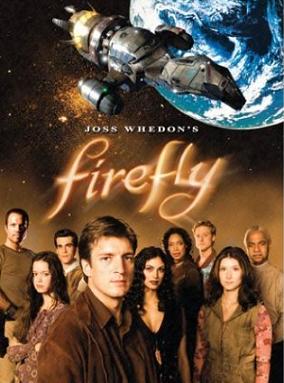 I finally had a chance to sit down and watch Serenity, the movie version of Joss Whedon's Firefly TV series.
On the plus side, it's about characters that seem very real, who are well-portrayed by decent actors. Despite the Sci-Fi setting, the situation is not too much strain on the old "suspension of disbelief." There are thrills. There are chills. More imagination is on display in this two hour film than you typically get in a week of television.
And David Krumholtz dies. Which is kinda cool in a way; but I'mnot sure why. Maybe because his muppet-like good looks don't telegraph the fact that his character will be killed off. Of course, I've just ruined that for you...
But: none of this is a stretch for Joss Whedon. You get exactly what you expect from him after 7 years of Buffy, 5 years of Angel, and 1 year of Firefly. No more; but fortunately, no less.
If you're a Whedon fan, this will disappoint you. I kept finding myself hoping for more. On the other hand, if you aren't familiar with Joss Whedon... This is a good place to start. But then go watch Buffy from the beginning. You could skip Angel, but you probably won't.
Holding out for a Zero...
 Is anyone out there at all excited about this year's Summer movie wonders:
Aliens vs. Predator 2, and
Fantastic Four 2: Rise of the Silver Surfer?
Yeah, me neither...
 I wasn't all that hot on Ghost Rider either. What little enthusiasm I mustered about seeing a live action Ghost Rider was fully satisfied by the commercials. "Oh, look! A flaming skull and possessed motorcycle." Been there, done that.
It's the same with these two films. AVP 1 was plenty, unless by some miracle they found a decent aspiring writer.
 And as for F4:2, at least they had the good sense not to reveal Galactus in the commercial.
Ho hum. So what is everyone waiting to see this Summer?
James Cameron "Finds" Jesus...
 James Cameron, noted filmmaker and the man who unleashed the raw sexuality of Leonardo DiCaprio upon a nation of unsuspecting teenage girsl, claims to have found Jesus.
Cameron, hitching his documentarian star to a fringe archeaologist, claims to have discovered a tomb near Jerusalem that dates back to the First Century AD and containing the earthly remains of Jesus, Mary (Magdalene, of course), and their male child.
If true, this could send shockwaves through Christianity as most -- if not all -- denominations believe that Jesus was assumed bodily into Heaven. It would also counter the Dan Brown/Da Vinci Code nuts who believe Mary Magdalene retired to the South of France and established the Merovingian Dynasty.
The Faithful, however, still have an ace in the hole on this. It seems the statistical occurance of names in First Century Palestine shows that variants of "Jesus" and "Mary" were extremely common. So there is no good reason to jump to the conclusion that this tomb belongs to that Jesus and Mary.
Wednesday, February 21, 2007
Since I suspect MiLK deserves a response...
"Wars not make one great." -- Yoda.
As I have mentioned several times in the past, I have an extensive martial arts library. But realistically, there are only a handful of books that I reapeatedly return to on a regular basis. One of those books is Living the Martial Way, by Forrest Morgan. I reread it at least once every six months.
Mr. Morgan is an Air Force officer with extensive experience in several different martial arts. He is, by almost any definition, a warrior. His whole book is dedicated to the notion that proper practice of the martial arts can (that's can, not will) enable someone to become a warrior.
When someone with his credentials says anyone can be a warrior, I listen. He believes warriors can indeed be found in every walk of life, not only in the profession of arms. In the section he devotes to this question, he points out that doctors, teachers, even waitresses can be warriors. These are people who demand excellence from themselves and those around them. They meet challenges head-on, and do not blame others for setbacks -- and certainly not their own shortcomings. They are standard setters for those around them.
Is he right? I still think there is a difference between those who willingly put themselves in the way of danger, and the rest of us. But I think his point is not to be taken lightly. It even has some history behind it. There are stories from Japan about masters of fine arts being accorded the same respect as samurai. The important trait was the dedication to excellence that made a master.
On story speaks of a teamaster who was challenged by a swordsman to a duel. He sought instruction from a samurai so he could die with dignity. The samurai sensed that this pursuit of even meager instruction in handling a sword indicated a pursuit of excellence. So he asked the teamaster to perform the tea ceremony as if it would -- as well it could -- be his last. The teamaster centered himself and went through the ceremony without a flaw. The samurai showed the teamaster the daijodan high posture and taught him to properly cut down from this position. "Do this with the same conviction you give the tea ceremony and you will at least die with dignity." The teamaster went to his duel and took up the daijodan posture. His opponent studied the teamaster for several minutes and finally bowed and left. He could sense the serenity of the teamaster in this single act. The swordsman might well have killed the teamaster, but he would not beat him.
Apocryphal? Sure, but it indicates that even in classical times, warriorship had many definitions. There are still times when I stumble on my journey to even this kind of metaphysical warriorship. I have decided that the trip is worthwhile because it makes me a better person.
I was a little angered by MiLK's dropping of the "whenever I return home..." paraphrase. This comes from Robert L. Humphery's Warrior's Code (which I'll quote from my sometimes shaky memory):
Wherever I go, everyone is a little safer.
Wherever I go, everyone in need has a friend.
Whenever I return home, everyone is happy to see me.
Mr. Humphery was a Marine in World War II. He fought on Iwo Jima. He knew warriors. And this was his distilled essence of warriorship. His Code was brought into the American Bujinkan community by Jack Hoban.
So while I do still think there is a difference between Warriors and warriors, I defer to men who have been both to help me see the similarities.
As I have mentioned several times in the past, I have an extensive martial arts library. But realistically, there are only a handful of books that I reapeatedly return to on a regular basis. One of those books is Living the Martial Way, by Forrest Morgan. I reread it at least once every six months.
Mr. Morgan is an Air Force officer with extensive experience in several different martial arts. He is, by almost any definition, a warrior. His whole book is dedicated to the notion that proper practice of the martial arts can (that's can, not will) enable someone to become a warrior.
When someone with his credentials says anyone can be a warrior, I listen. He believes warriors can indeed be found in every walk of life, not only in the profession of arms. In the section he devotes to this question, he points out that doctors, teachers, even waitresses can be warriors. These are people who demand excellence from themselves and those around them. They meet challenges head-on, and do not blame others for setbacks -- and certainly not their own shortcomings. They are standard setters for those around them.
Is he right? I still think there is a difference between those who willingly put themselves in the way of danger, and the rest of us. But I think his point is not to be taken lightly. It even has some history behind it. There are stories from Japan about masters of fine arts being accorded the same respect as samurai. The important trait was the dedication to excellence that made a master.
On story speaks of a teamaster who was challenged by a swordsman to a duel. He sought instruction from a samurai so he could die with dignity. The samurai sensed that this pursuit of even meager instruction in handling a sword indicated a pursuit of excellence. So he asked the teamaster to perform the tea ceremony as if it would -- as well it could -- be his last. The teamaster centered himself and went through the ceremony without a flaw. The samurai showed the teamaster the daijodan high posture and taught him to properly cut down from this position. "Do this with the same conviction you give the tea ceremony and you will at least die with dignity." The teamaster went to his duel and took up the daijodan posture. His opponent studied the teamaster for several minutes and finally bowed and left. He could sense the serenity of the teamaster in this single act. The swordsman might well have killed the teamaster, but he would not beat him.
Apocryphal? Sure, but it indicates that even in classical times, warriorship had many definitions. There are still times when I stumble on my journey to even this kind of metaphysical warriorship. I have decided that the trip is worthwhile because it makes me a better person.
I was a little angered by MiLK's dropping of the "whenever I return home..." paraphrase. This comes from Robert L. Humphery's Warrior's Code (which I'll quote from my sometimes shaky memory):
Wherever I go, everyone is a little safer.
Wherever I go, everyone in need has a friend.
Whenever I return home, everyone is happy to see me.
Mr. Humphery was a Marine in World War II. He fought on Iwo Jima. He knew warriors. And this was his distilled essence of warriorship. His Code was brought into the American Bujinkan community by Jack Hoban.
So while I do still think there is a difference between Warriors and warriors, I defer to men who have been both to help me see the similarities.
Subscribe to:
Posts (Atom)