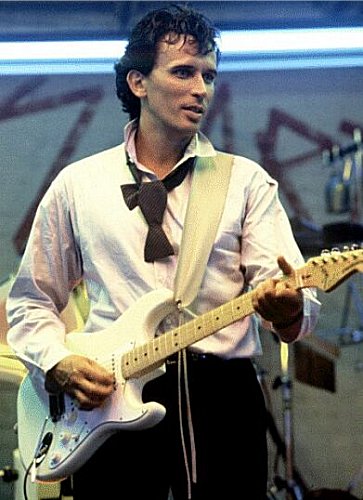
Any out there besides me remember The Adventures of Buckaroo Banzai: Across the 8th Dimension? The hero was a rock n rollin', philosophy spoutin', six-gun slingin', neurosurgeon/astrophysicist, and probably a bunch of other things. This was a geek-fest starring Peter Weller in the title roll, Jeff Goldblum as his chief sidekick, opposing the evil antics of John Lithgow and Christopher Lloyd. To be fair, the idea of a pulp action hero with as much in the brians department as the brwn department isn't new. Doc Savage, the man of bronze, was plying those waters many, many years ago. But, you never got the sense from Peter Weller that Dr. Banzai's churning waters ran very deep.
Sunday, January 28, 2007
Paging Dr. Banzai!
Any out there besides me remember The Adventures of Buckaroo Banzai: Across the 8th Dimension? The hero was a rock n rollin', philosophy spoutin', six-gun slingin', neurosurgeon/astrophysicist, and probably a bunch of other things. This was a geek-fest starring Peter Weller in the title roll, Jeff Goldblum as his chief sidekick, opposing the evil antics of John Lithgow and Christopher Lloyd. To be fair, the idea of a pulp action hero with as much in the brians department as the brwn department isn't new. Doc Savage, the man of bronze, was plying those waters many, many years ago. But, you never got the sense from Peter Weller that Dr. Banzai's churning waters ran very deep.
Momofuku Ando
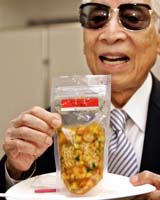
On January 5th, 2007, at the ripe old age of 96, Momofuku Ando, founder of Nissin and the inventor of instant noodles, died.
I found his obituary in the back pages of hoity-toity The Economist, a weekly newsmagazine that I feel into the habit of reading several years ago while studying for a job interview. (Don't ask.) The obit is very wry. It likens the instant gratification and simplicity of instant Ramen noodles to the search for enlightenment. Apparently this is not merely the low-wit of the author, because Mr. Ando had three sayings that served as Nissin's motto:
Peace will come when people have food.
Eating wisely will enhance beauty and health.
The creation of food will serve society.
Talk about a mission statement. No wonder Japanese business is such tough competition.
Anyway, instant noodles are the kind of thing you take for granted. You just assume they've always been around. Not so. Mr. Ando got the idea while walking home from work in 1957. He saw the long lines of people waiting at the noodle shops, which were the Japanese equivalent of McDonalds back in the day. I say "were" because I suspect McDonalds is now the Japanese equivalent of McDonalds, but I digress.
It took Mr. Ando a year to perfect the process of creating the instant noodle. The secret? Flash-frying the fresh noodles in palm oil. But here's the bit that really surprised me -- as it will surprise almost any student in higher education:
Mr. Ando was laughed at and repeatedly told he would fail because... the instant noodles cost 6 times as much as a bowl of fresh noodles! Hard to believe when you can take home a grocery bag full of the things for pocket change.
Well, we will all miss Mr. Ando in our own ways. But he did something extraordinary by making so many millions happy with something so incredibly simple, and even if he is forgotten, I'm sure his legacy will continue forever.
Wednesday, January 17, 2007
Basics
While I certainly would never in a million years claim they know true ninjutsu, they do have an excellent understanding of samurai and martial arts history. And being Japanese, they provide an added insight into the mythology and history surrounding the samurai and ninja cultures. It is very different from the Hollywood idea of the legends we have in the US. The shadow of Sho Kosugi does not fall on Koike and Kojima.
Sunday, January 14, 2007
National Marine Corps Museum
Tun Tavern still lives today. And, Tun Tavern beer is still readily available throughout the Philadelphia area. Further, through magazines it is advertised to Marines throughout the world.
The United States Marine Corps is older than the Republic for which it stands. For over 200 years, it has stood guard over our country and taken the fight to our enemies wherever they slept. The Corps is very proud of its history, and insists that all new recruits learn a fairly detailed account of dates, names, and places important to the Corps' heritage. Yet, until last November 10, there was no central, National Marine Corps Museum.
The actual flag from the famous Iwo Jima picture is on display at the Museum, across from a war studded with globes and anchors, one for each Marine who died in the gray, sulfur sand of that godforsaken place. In the Korean War Gallery, there is a room size diorama of a winter battle, kept chilled by air conditioners. Personally, I think it was still too warm in there, and I'd have dropped the temperature more, but it gets the point across.
I recommend the museum. I'd like to go back some day and spend more time. We were there for four hours, and it was no where near enough time to soak it all in. We missed a few things -- including the Tun Tavern mock-up that serves as a dining hall. And I decided against trying out the indoor rifle range with it's five dollar cost and laser rifle training tools.
Oniyuri Shinobigatana Review
Sunday, December 17, 2006
Yagyu Shingan Ryu Techniques
This is not classical koryu... But it's still fun to watch...
Wednesday, December 13, 2006
Some essays on Ma-ai...
There is no set rule for ma-ai, and the "critical distance" varies according to the bodies of the individual opponents and the tools engaged in the encounter. The determining of ma-ai is not intrinsically difficult. As has been pointed out (most recently by He Who Shall Not Be Named!), most people have a sense of their own comfort zone for conversation. Interestingly enough, although this comfort zone does differ from culture to culture and person to person, in the West, it generally extends to the limits of defensible distance.
If you want to see what I mean, the next time you have a standing conversation with an acquaintance, set a distance. Then try to shuffle forward as unobtrusively as possible. Even if your action is not threatening or alarming, the other person will probably take a noticiable step back to reset the original distance. You can expand your experiement by trying the same trick on a good friend. Chances are good the friend will let you get closer. But even so, if there is no perceived "need" for you to be so close, you may notice your buddy begin to get uncomfortable.
You can also watch ma-ai while driving. Tail-gating is bad ma-ai. But more importantly, the "critical distance" between you and the car in front of you will change depending on road and weather conditions, and the type of vehicle you are driving.
Sparring seminar...
However, from a teaching point of view, I'm not sure that's always 100% true. Because the student's understanding of why he does anything should constantly improve.
I expect a beginner to say, "I have no idea why I'm doing this other than myteacher told me to, and I trust him." I think that's valid.
Somewhere in the middle, the student should be able to explain that the kamae is optimal for defense, offense, mobility, etc. How the student expresses that is going to change. Defense and offense might be defined as having the arms up to block strikes and be available for punching in response. Later the student might describe how blading the body protects the vital areas, and that three of the four weapons (2 hands, one foot) are between you and the opponent.
The student will later talk about more subtle concepts, "I feel right in this posture; I'm ready to act." Or be able to explain how and why power can be generated from the hips and knees more efficiently.
I think the most advanced people are fully aware of these parts, but probably (and legitimately) they go back to, "I've been doing it so long, I'm comfortable with it. I trust that it works, because I've experienced it working."
I'm told that our dojo needs, as a group, to work on bending our knees. We've been hearing that for ages. I was watching HWSNBN! demonstrate, and paid particular attention to his legs. He does get low, and he uses a rocking motion to create an illusion of distance for his opponent. Maybe the importance of the low knees will drive home when I finally understand the manipulation of ma-ai in that way.
I've also heard, in an ominously vague way, that some students, "Didn't seem to have a grasp of Gyokko Ryu Ichimonji." Comments like that cause me to ponder on my own training and lead to the first few paragraphs above.
Here's a training tip: Always assume that a criticism of your group automatically applies to you. Think long and hard about it. Never, ever, hear yourself say, "I'm glad he's not talking about me." He probably is talking about you in that case.
Gambatte!
Sunday, December 10, 2006
Wednesday, November 29, 2006
Oh boy...
Only in America.
Now, which of you said that the Bujinkan is like a Comic Con, only without the hot chicks? Sky Ninja, was that you?
Wednesday, November 22, 2006
Soapbox Issue: Jim Wagner
Who's Jim Wagner? Glad you asked. Jim Wagner is a frequent contributor to Black Belt Magazine, and also the many editions of Budo International. He is a "Reality Based Fighting" martial arts instructor who spreads his knowledge through high-priced seminars, a video series , and a book. Prior to his breakthrough into the Martial Arts Media mainstream, he served as a "police and military defensive tactics instructor" (that's straight from the brief bio provided in Black Belt) with several different departments and agencies, and also as a "counterterrorist for the United States government [sic] after 9/11." (That's from the marketing material touting his New York City seminar to be held in the new future.)
Do I dispute his credentials? Let me make this completely clear: I do not. I am ready to believe he is absolutely 100% telling me the truth.
Do not mis-quote me on that. I believe his "stuff."
And because I believe him, that's what burns my butt.
Mr. Wagner writes a regular column, High Risk, for Black Belt Magazine. Desperate for my martial arts information fix, I have a subscription to Black Belt and look forward to receiving it every month. Yes, I know 80 - 90% of it is pure drivel; I'm still hooked for the same reason I read Entertainment Weekly. I read it cover to cover. And generally speaking, I think the informatio Mr. Wagner shares is worthwhile.
My problem is with the enormous ego that oozes off the page. He's like a greasy used car salesman but his product is himself. Like the car, it may be a great product; but the sales technique completely turns me off.
Here's how he starts his most recent column: "Because of your votes, I was recently inducted into the Black Belt Hall of Fame as 2006 Self-Defense Instructor of the Year." Well, no kidding! I read the write-ups for this year's Hall of Fame Inductees last month! I also noticed that Dana Abbott, voted Weapons Instructor of the Year 2006, didn't mention it even once in his column this month. (And let's not get into the fact that the columnists seem to be the ones winning the awards. That's probably my soapbox issue for next month.)
Mr. Wagner is in love with the use of "I" in his writing. Here's the first paragraph of his article contribution in the same magazine: "Four years ago, the martial arts community outside of Israel knew of only one Israeli art: Krav Maga. Then, after returning from my third trip to Israel, I wrote an article for Black Belt that introduced other popular systems of the Holy Land, including Lotar, the fighting system of the nation's counterterrorism school, and kapap, Israel's original close-quarters-combat style."
The very next sentence? "After I convinced kapap expert Maj. Avi Nardia to go public with the system..." I thought about counting the actual number of times he uses "I" in the article about Maj. Nardia, Kapap, and it's coming to the West, but I kept losing count.
Here are some other reputation (i.e. ego) enhancing quotes from Mr. Wagner:
"...I stood with Nardia assessing dozens of special-forces recruits. His job was to select those who would make good candidates for the program, as well as those who would be asked to leave at the end of the day. 'What do you think of that one?' he would ask me. I would respons, 'Yeah, he's special-forces material.' Nardia would then say, 'I'm putting his name on the list.'"
Let me get this straight: American citizen Jim Wagner is selecting Israeli commando trainees? Really? Would I believe that statement if Israeli citizen Nardia said he was selecting Delta Force candidates? I'd sure raise an eyebrow.
"His [i.e. Nardia] first two years were rough... I arranged some kapap seminars for him, designed the art's logo and hooked him up with some contacts in Europe."
"People would post vicious messages on the forums on Nardia's website, often sayng that he lacked the credentials he claimed to possess. I knew exactly what he was going through because I often sustained similar attacks inspired by my Black Belt column High Risk."
Here's a writing tip, if you want to tell someone's story, then tell their story. Do not insert yourself into the story. As a reader, it is very distracting.
Now let's talk about that "counterterrorist for the United States government after 9/11" credential. True. You bet. I have independent confirmation on this too. Mr. Wagner was employed by the American taxpayer as a Federal Air Marshal after 9/11/2001. And if you ask him about his counterterrorist experience, he is apparently very up front about this.
My first issue: yes, technically speaking, a FAM is indeed a "counterterrorist." And believe me when I say, I completely and totally respect a FAM's training. I have every reason to respect it. However, there is a world of difference between being local SWAT cop, and being a FAM, and being a Navy SEAL in DEVGRU, or being a JSOC supertrooper. And for that matter, there are plenty of analytical weenies employed by Uncle Sugar who also proudly wear the title "counterterrorist." All of these people have good reason to be proud of their service, but Mr. Wagner is being rubbery by using the word in his marketing. Why not say, "Former Air Marshal?" Not as sexy.
Here's something else. Based on my reading of a Budo International article that was Mr. Wagner's own account of his FAM stint, he completed his service on 9/11/2002.
Yes: 2002. That means he was hired, provided clearances, trained (at great expense to the taxpayer), and deployed on flights all in the space of a year.
Now, if someone knows different about how long Jim Wagner's experience as a FAM lasted, I'd love to see the evidence. But as a taxpayer, I'm a little disappointed that my security was used as a stepping stone for Mr. Wagner's resume. I'm sure his seminar fee increased based on the line item: "counterterrorist." Sorry if I seem cynical about this point. Maybe I'm just posting another vicous attack based on his column.